Why...

Two mature aged people who love travelling and learning along the way... Our names are Rob (Robyn) & darian in the 60+ vintage of travellers keen to visit parts of the world which will stretch us mentally, physically and emotionally.

10 July 2018

Peru Part 1. – Lima to Colca Canyon - 2018

The plan was to only create one post on Peru but as our travels within Peru progressed it soon became obvious this would be difficult, so here is Peru Part 1., Lima to Colca Canyon.

By the map below you can see our route and the prime destinations we stopped at during this part of our Peruvian travels.
Key destinations in Peru during Part 1. of our travels
Lima
We had flown into Lima Airport a few times this trip on the way to somewhere else, each time, this city of 10+M, seemed grimy and dull. 

This time, when flying in from Bogota Colombia, we were staying in Lima as the start of our visit through Peru and its almost 33M population. Again it still appeared grimy, with a dull grey sky and what looked like layers of thick dust atop the buildings near the airport at least.
Flight from Bogota, Colombia to Lima, Peru
Our Spanish only speaking driver greeted and hurried us to his car, but before we left the airport gates, insisted through gesture we lock both our rear doors, the front ones had already been locked.  Hmmmm, we thought!

We soon knew why as we entered the seething mess of traffic going every which way, each driver trying to bluff their way in front of someone else.  We naturally did the same and it was a little bewildering because some bluffs were more aggressive than others.

We only had a one-night stay in a suburb called Miraflores, reputed as being very safe in this cauldron of a city.  Indeed, Miraflores was a very pleasant area compared to how our entry to Lima started and it wasn’t long before we were out and about exploring it.
Public space artwork within Miraflores
Our son Callan had stressed we enjoy one of Lima’s very good reputations… good food, so we did and he was right.  Lima has a disproportionate number of very innovative, high quality restaurants to choose from.

Our guide met us next morning and we started a city tour of both Miraflores and Lima, starting at an ancient massive mud brick pyramid like temple called Huaca Pucllana.

Its about 500m in length, 200m in width and 22m in height, is being restored and was built around 500AD.  Being a religious and administrative centre, it was used amongst other things, for human sacrifices to the gods by the local Lima culture.
Small section of Huaca Pucliana 'pyramid' built using mud bricks 1,500+ years ago
Whilst in Miraflores, we learned that Lima is misty/cloudy very often due to the influence of the Humbolt current on the city, bringing cold water to its shores from Antarctica.  The constant cloud however brings little rain and hence the reason so many buildings from the air look dusty.
Mist over ocean around Miraflores caused by Humbolt current
Soon we were in the heart of the original colonial area of Lima city, visiting a few of the old churches, one with incredible timber work in it, before venturing down into the catacombs where ~70,000 people are believed buried, bones and skulls stored neatly throughout.
Incredible timber decorations in one of Lima's prime churches
Lima has a nicer ‘heart’ than our first impressions suggested when we finally reached the main square with its beautiful 300-year-old fountain at its centre.
Section of main square in Lima
Old colonial buildings in central Lima
Paracas
Our time in Lima was soon over and we boarded a Cruz Del Sur bus to travel south along the Peruvian coast.  South America is renowned for its comfortable long distance buses and it proved a great way to really see the countryside, especially in Peru.

These buses are very comfortable to travel in
For a start, most of the countryside we saw is typically VERY barren, no trees, grass, shrubs… nothing.  There is plenty of dull brown dirt, mountains and rock and people living near the highway in small, rustic timber shacks.  Might sound a little boring to you but it wasn’t.

Occasionally we would descend down along a very windy section of highway from the dusty dry plateau towards a riverbed and would almost be shocked to see lush green market gardens full of vegetables, before then climbing back up to the dry, barren countryside.
Descending into the occasional lush valleys from the barren plateaus
After a 4hr bus trip we pulled into Paracas located right on the coast and unfortunately, our transfer wasn’t there.  We discovered our hotel was only a few hundred metres away, so we walked to it instead and checked in, a very embarrassed driver turning up about 15mins later.

The hotel was massive with a huge pool, great room with views to the ocean and many boats bobbing out the front of our window.  Next day we learned why we were really here whilst in a queue with a few hundred other people, all waiting to board their allocated speedboats.
View from our room in Paracas overlooking the pool and beyond
Soon on a boat we headed out to sea, our first stop being the mysterious prehistoric geoglyph, Paracas Candelabra, estimated to have been created in at least 200BC if not earlier.  It is 40cm deep, with rocks placed either side of the ‘carving’ into hardened soil and is up to 200m tall.  Impressive… even if under gloomy skies.
Style of boat used to visit the scenery off Paracas
The massive 2,200+ yr old Paracas Candelabra geoglyph
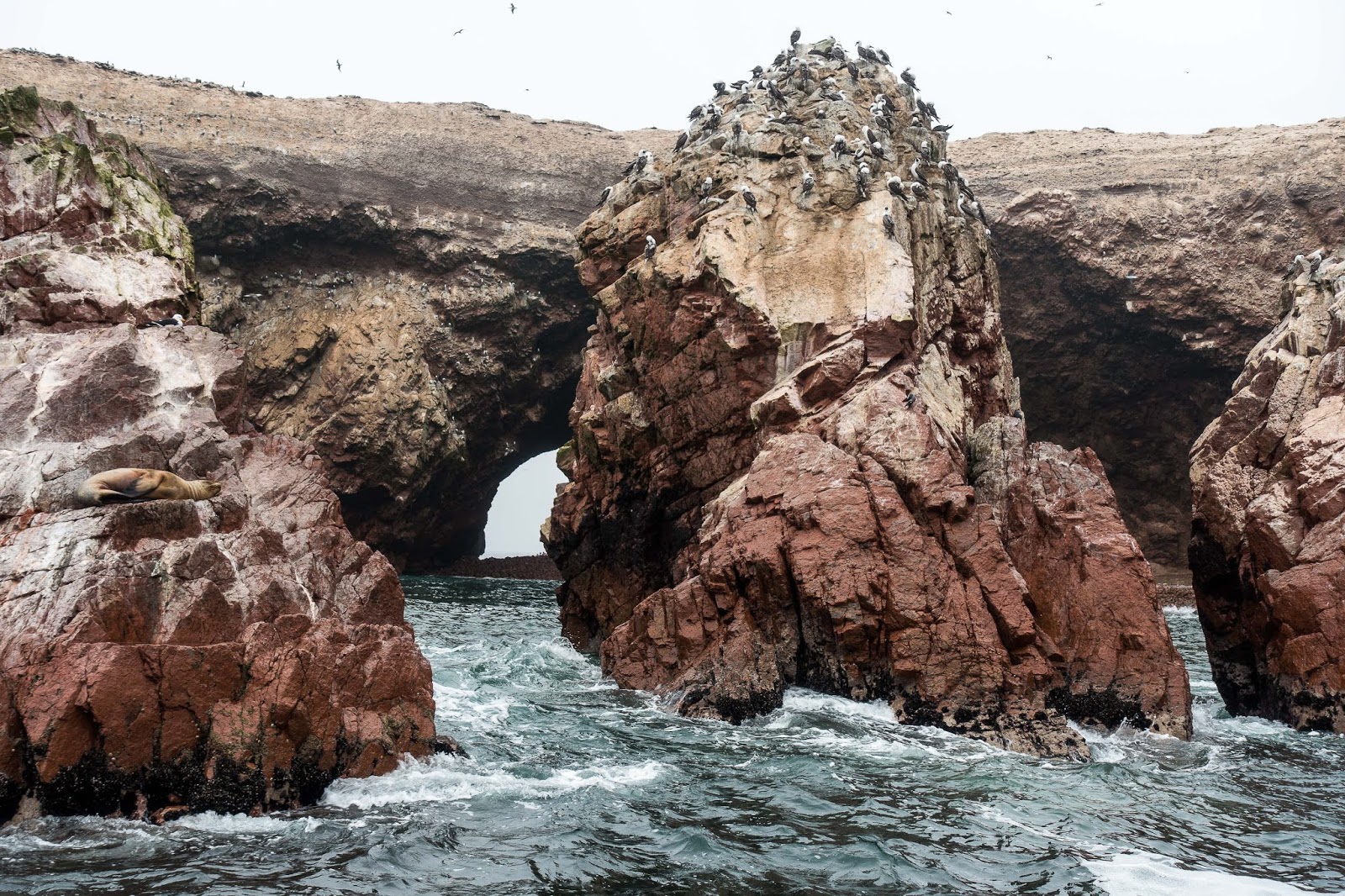
Off again we sped further out to sea until we saw massive numbers of birds congregating together and diving into the water to feed.  We soon saw where the constant stream of birds were coming from, our destination, Ballestas Islands, a national reserve for wildlife as well as a collection area for guano (shit).
A few birds flying out from the islands to feed
typical landscape of one of the islands
Birds, birds and more birds still on one of the islands
These islands are home for 1,500 species of birds and a large number of sea lions.  
Pretty laid back sea lions
There were certainly a LOT of birds on the islands, probably millions of them and some of the stand out species were:

Humboldt Penguins
A group of Humbolt penguins heading down to the ocean
Peruvian Pelican
Preening Peruvian pelican
Guanay Cormorant
A few Guanay cormorants
Red Legged Cormorant
Quite rare Red Legged Cormorant
Peruvian Booby
Peruvian Boobies
Inca Tern
Inca Tern
It was a staggering display of huge numbers of birds either heading to sea to feed or looking after babies… quite amazing.
More birds going off to feed
As soon as we reached back to the shore we were rushed back to the bus depot to catch another comfortable bus, this time a 3hr trip with our destination this time being Nazca.
Some of the local fishing fleet

Nazca
Early next morning we were meant to be picked up at 7am, but this was delayed due to foggy weather, so we had to wait patiently for a few hours till it lifted enough for us to make our way to Nazca Airport and our 30 min flight over the famous Nazca lines.

When it was time to board the little single engine Cessna, due to my size, in smaller planes they usually put me up front.
Our plane for the flight over the Nazca lines
This time, Rob and I had to squeeze into the back 2 seats of the plane, a somewhat robust lady in the hip department taking the seats closer to the front after she had managed to finally prize her way through the entry door.

With cameras and faces squeezed up next to the windows and flying at only 500m above the ground, it was fairly easy to see each of the famous geoglyphs in the still dull skies, banking left then right, so each side of the plane could get good views over each of them.
Our actual flight path over Nazca lines, including when we circled individual geoglyphs
Was worth both the wait and effort to finally get to see them!
Man on the side of a mountain
Hummingbird
More interesting Nazca Line shapes
After being dropped off back in Nazca, we eventually boarded our next bus, this time for a much longer trip. The bus left late at 2:30pm and was delayed en-route for a while by a road accident involving a truck rollover.

Arequipa
12 hours later we arrived into a city called Arequipa, were taken to our hotel and finally got to sleep around 3:30am, very tired indeed.

At 9:00am our guide arrived to start a tour of this city, which sits at 2,335m above sea level, starting with a viewpoint overlooking a fertile valley along a river.
Fertile valley in Arequipa
Arequipa also has 3 large volcanos nearby, El Misti and Chachani which are both active, one only a mere 14kms from the city and then a little further away, Pichu Pich which is dormant.
One of the volcanoes near Arequipa
Part of our tour was to visit the monastery De Santa Clara, which was truly fascinating, and like a small town within a city.  The monastery was built in 1579 and then enlarged during the 17thcentury.
New species of hummingbird we saw in Arequipa
It was built primarily out of white volcanic rock of which there is abundance in Arequipa and the colour of the rock was so glary for monastery inhabitants, the buildings were painted in bright colours.


Various scenes from within the De Samta Clara monastery
Young rich girls came here to learn a variety of life skills, quite often with a servant living with them in their small rooms, and they could decide later to stay and become a nun if they wished.  

300-400 people lived here at its height and the average life span of its occupants was ~40yrs… it was a strict and very disciplined life.
Kitchen facilities
Open air laundry where clothes washed by hand
Arequipa itself was a very nice stylish city with an old colonial section, large central square containing its cathedral and other important buildings and an abundance of good restaurants and quality shops selling alpaca and vicuña clothing.
Cathedral in the main square
More of the historical and elegant buildings of Aewquipa

Colca Canyon
It was an interesting 4 hr drive leaving Arequipa to the town of Chivay, first having to circle Pichu Pich volcano and then starting to climb constantly in altitude.
4,000m altitude plateau on way Chivay with Pichu Pics volcano in distance
The countryside was barren with short brown grasses covering it, which was popular with small groups of vicuña, lamas and alpacas grazing contently next to the road.
Group of vicuña
Grazing lama
Nearing Chivay was an observation point most tourist vehicles stopped at, including ours, at an altitude of 4,919m, the highest we had certainly reached, and in the distance could be seen Sabancaya volcano erupting and belching smoke high into the sky.
Scenery at almost 5,000m above sea level
We had been driving for a while on a high plateau and to reach Chivay had to descend down a steep stunning zig-zag road, reaching an adobe style hotel for our overnight stay.
The drive down from the plateau ti Chivay
Next morning on the way to Colca Canyon, we visited a few small villages perched in the valleys, witnessing dancing by young people in traditional dress and visiting a few very old churches.  
Young local dancers in traditional dress
More active Sabancaya volcano which almost destroyed the village years prior
Most villages were also surrounded by large and impressive 500-700 year old terraces built by the Incas and used for growing food, some still in use.
Ancient Inca terraces still exist
So the time had come to visit Colca Canyon itself, one of the deepest canyons in the world at 3,270m and not massively wide, which made for some spectacular views.
Looking down into Colca Canyon
Apart from the great scenery, Colca Canyon is also a famous viewing location, if you’re in luck, of South America’s largest bird standing at 1m tall and with a 3m wide wing span… the South American Condor.

Well we were in luck when we spotted some flying along the edge of the canyon, so we parked the vehicle and walked about 1km to reach their location.  It was very windy which meant great flying conditions for the 20-30 condors in this location.

It was fantastic to see them sitting about 20m from us on the edge, a combination of adult and juvenile birds before launching themselves off the edge of the cliff and catching the wind to soar effortlessly back and forth below us.
Adult condor doing what they do best, soaring on the winds 
Juvenile condor
Other condors were resting together; some stretching their huge wings and a few were engaged in mating.  It was a fabulous privilege to be in their company!
Resting condors perched on the edge of Colca Canyon
A condor stretches its huge wings
Eventually we had to drag ourselves away and make the drive back to Arequipa, very satisfied at what we had seen during the entirety of this visit to Colca Canyon.

After a very pleasant night back in Arequipa, it was an early morning start and a trip to the airport for the beginning of Part 2. of our Peru travels and something I had personally been keen to see for 40+ years, so until that post… go well!

CLICK HERE - More photos of Peru Part 1. Lima to Colca Canyon


4 July 2018

Colombia - 2018

Before arriving into Colombia, and despite our planning and good friends telling us it was a great place to visit having been there a few times, we remained concerned about safety.

Colombia is where Pablo Escobar, once the richest man in the world because of drug running, lived and died violently.  He was responsible for many deaths in Colombia.

In the same country, a Marxist based rebel/terrorist group called FARC that still exists, was responsible for thousands of Colombians being killed, kidnappings, ransoms and drug running.  More recently, a peace deal is trying to be brokered with FARC, resulting in a massive drop in violence by them.

And there are still paramilitary groups who also run drugs and kill people.

So with this sort of reputational background, wouldn’t you be nervous, but due to our friends’ consistent reassuring words, we decided to go.

Our complete route through Colombia is shown below and the cities we stayed in.
3 cities in Colombia we visited
Cartagena
First stop in Colombia involved flying from Quito via Bogota to Cartagena located on the coast of the Caribbean Sea.
As soon as we had cleared customs, collected our bags and stepped out onto the streets, the heat and humidity hit us along with a Caribbean style energy, and once again we found ourselves crammed into a small car for the transfer to our hotel.

Our Casa (hotel) was located on a narrow street, in the old town of Cartagena, hidden behind a wall with a small door.  Immediately the colourful facades of most buildings in the street struck us, including the ornate timber colonial balconies on most.
Colourful interesting Cartagena
We were back out into the streets quickly to find somewhere to eat and following directions to a supermarket to buy bottled water.  

Walking down any of the streets of Cartagena was a buzz because of the colour, the energy, the activity or music to be heard and then there were the people, those very, very laid back, warm and friendly people.
Very lively square not far from our Casa (hotel)
In the supermarket we bought 2 large bottles of water, no big deal you would think until you have to pay for them the first time… in millions of pesos.

Well that’s what it says on their notes, but the locals talk of thousands of pesos even though they are actually millions!  Confused, don’t blame you because we were for a little while also!


Some more of the character and colour that is Cartagena
To get to know the city, we used a hop on/off bus for most of the first day combined with lots of walking, including visiting the massive Castillo San Felipe de Barajas, a fortress in the city of Cartagena, built by the Spanish and the largest fortress they built in South America. 
The Castillo San Felipe de Barajas is an impressive fortress
The fortress is located on the Hill of San Lázaro in a strategic location, commanding approaches to the city by land or sea.  Construction began in 1536, it was then expanded in 1657 and it took a very long time before it was assailed.
The fortress has massive walls
We also arranged to do an island hopping day tour along the Rosario Island group which required a 6:00am collection from the hotel before then picking up 2 Argentinians, a German and another from Chile during our 1hr drive to some weird place on the coast.
Our Rosario Island hopping route
Only use the word ‘weird’ because we ended up walking down a beach amongst what looked like shanty shacks acting as rustic mini resorts, no… strike the word ‘resort’.
The myriad of 'resorts' along the beach
We stopped at one, our guide suggested that if we needed to use the banos (toilet), now was the time to do so but please collect your own water from the large barrels outside using the plastic containers in them to flush after yourselves.

Other hardy souls had also joined us, so with that, 15 of us waded a little way into the water to board the boat and head out to sea, not an island in sight.
The trusty boat that took us island hopping
After a bit of bouncing over waves, we finally arrived at some small islands of the rich and famous where there is a large house on each small island.
Island and home of the rich
After cruising past a few, it was time to go snorkelling in the warm waters of the Caribbean Sea and it was a pleasant change from being bounced around.

Then it was onto another island where we stayed briefly, then to another where we stayed for about an hour, enjoying a few swims to cool off along with watching part of a World Cup soccer game in a rustic roof only bar near the ocean.
Some of the islands had bars in the warm ocean
Finally we headed back to the mainland to have lunch on the first floor of one of those shanty style ‘resorts’, which was a little better than the first ones we saw.
Lunch was enjoyed under the blue canopy overlooking the beach
We had a great time with this multi-country group of young people during our day of island hopping and enjoyed our time in Cartagena but now it was time to head to our next location in Colombia… Medellin.
It was farewell to the warm friendly people of Cartagena

Medellin
We had planned to fly into Medellin, the original home of Pablo Escobar, early in the day, to give us time to explore the city, BUT our plans were ruined by changed and then delayed flights… finally arriving into Medellin around 6pm.
Real pity because it’s a very interesting looking city, nestled down amongst tall mountains, lots of fairly tall apartment buildings, the only city in Colombia with a Metro and a reputation for innovation which includes using cablecars.  

As we drove into it and then walked around at night, we were also impressed with how neat it was, unlike Cartagena.  The other thing that immediately stood out was how friendly the people were… again.

For our only full day in Medellin, we had organised a coffee plantation and city tour of Jardin, and on time, Julio picked us up in a very small and short wheelbase van.  Why mention this, as on any rough roads which there were a few, we ‘enjoyed’ more natural massages.

Getting to the plantation took 2.5hrs south west of Medellin following rivers and up and down through large green, picturesque mountains. There were many small villages to go through built close to the road, and a road team clearing the remains of an avalanche.

We also stopped briefly at a roadside café for coffee, again enjoying a game of the World Cup with very passionate locals.
Roadside cafe to enjoy great Colombian coffee and Work Cup football
Along the way, Julio, a person who likes to laugh a lot, gave us a lot of information about Pablo Escobar, who during his drug running reign, owned at least 500 homes in Colombia.  He changed some furniture in them every month at a cost of US$500,000, giving the old furniture away to the poor as away of laundering money.

To get to the actual plantation involved eventually having to climb into the tray top back of a 1957 Willys Jeep and bouncing our way up a steep rough rocky track to the top of a mountain.

Here the family who run the small coffee plantation greeted us at their home, overlooking a stunning valley, with tall mountains surrounding it in the distance.
The valley view from the coffee plantation
They were soon preparing a cooked lunch for us and then we started learning about growing and preparing coffee, Rob being handed a basket to collect the beans from a few trees in the plantation.
Delicious home cooked lunch...
...then get stuck into some work
The trees have been planted on the side of the mountains, which simply means these hardy people have to pick their crop by hand whilst also walking up and down along the sides of quite steep mountains.  Hard work indeed.

Next we were shown how they extract the beans from their surrounding husks on the fruit using a machine, before then taking the beans and spreading them across a large flat surface on the roof of their home.
Machine which extracts 'green' coffee beans from the fruit
Naturally we had to taste their fresh Colombian coffee and it was truly delicious, in fact, Colombian coffee is the best coffee I have tasted in the South American countries we had visited so far.

After a great visit, it was back down the rough rocky track, into our diminutive van as Julio took us to the very colourful colonial city of Jardin.  But before going into the city proper, it was time for yet another cable car ride across a valley.

This ‘cable car’ was actually an enclosed box we all had to climb into, originally used for ferrying food and stores across the valley. After being pulled across the valley to a café/bar on the other side, the views back to the city were excellent, as was the Colombian beer.

The little 'cable car' we took across a valley overlooking Jardin
Finally we had the opportunity to drive into and wander through the city of Jardin, finding our way to the central square past many very colourful buildings, where we stood admiring the church, a national treasure in Colombia.
One of Colombia's national treasures in Jardin


Inside the very colourful and nice city of Jardin
As we drove back to Medellin, 2 things were different, it started to rain and the amount of traffic coming out of Medellin had increased significantly.  It was a long weekend and streams of people were leaving the city in cars but also a lot on motorbikes.

We had learned since arriving in South America, their driving habits on open roads, especially where double lines are involved is at times exciting if not downright dangerous.  This was the situation we found ourselves in with a few near misses adding to our collective ‘excitement’, even for Julio.

Our excitement wasn’t over as the rain increased and just as we reached the site of the avalanche being cleared earlier in the day, a brand new mud avalanche occurred, splattering the side of our van as we barely made it through.  Even the jovial Julio’s eyes widened!

Medellin and surrounding areas had been very enjoyable, albeit brief, but next stop was Bogota.


Bogota
A mere 5 years ago, Bogota was in the top 10 most dangerous cities in the world because of the organisations that kidnap people for money or political negotiations, drug dealers and gangs that ruled the streets.

Bogata is now a sprawling city of 10.3M people!
Sprawling and dynamic Bogota
Things have changed for the time being and we stayed in a suburb, which was serene, delightful, with many excellent restaurants around a central park and very safe to wander through.
Boutique brewery near our accomodation
Nearby fast food
We did 2 tours in and around Bogota, the first a city tour which taught us a lot about this citys’ colonial Spanish past, the large central square, churches naturally, the President’s Palace and the colourful guards who protect it.
Main square and Cathedral
Some of Bogota's colonial past
The Presidents guard
One of the many characters you see whilst travelling
More of Bogota's colonial past
Famous Colombian artist - Fernando Botero's take on Mona  Lisa
We also visited the Zipaquira Salt Cathedral, a huge underground complex built within the now unused underground sections of a salt mine outside of Bogota.  

As we descended deeper into the complex, a progressive religious story was told in stages through carvings made into the salt rock, until we reached the underground church with its chandeliers also made out of salt.
One of many examples within the Salt Cathedral 
The underground cathedral including salt chandelier
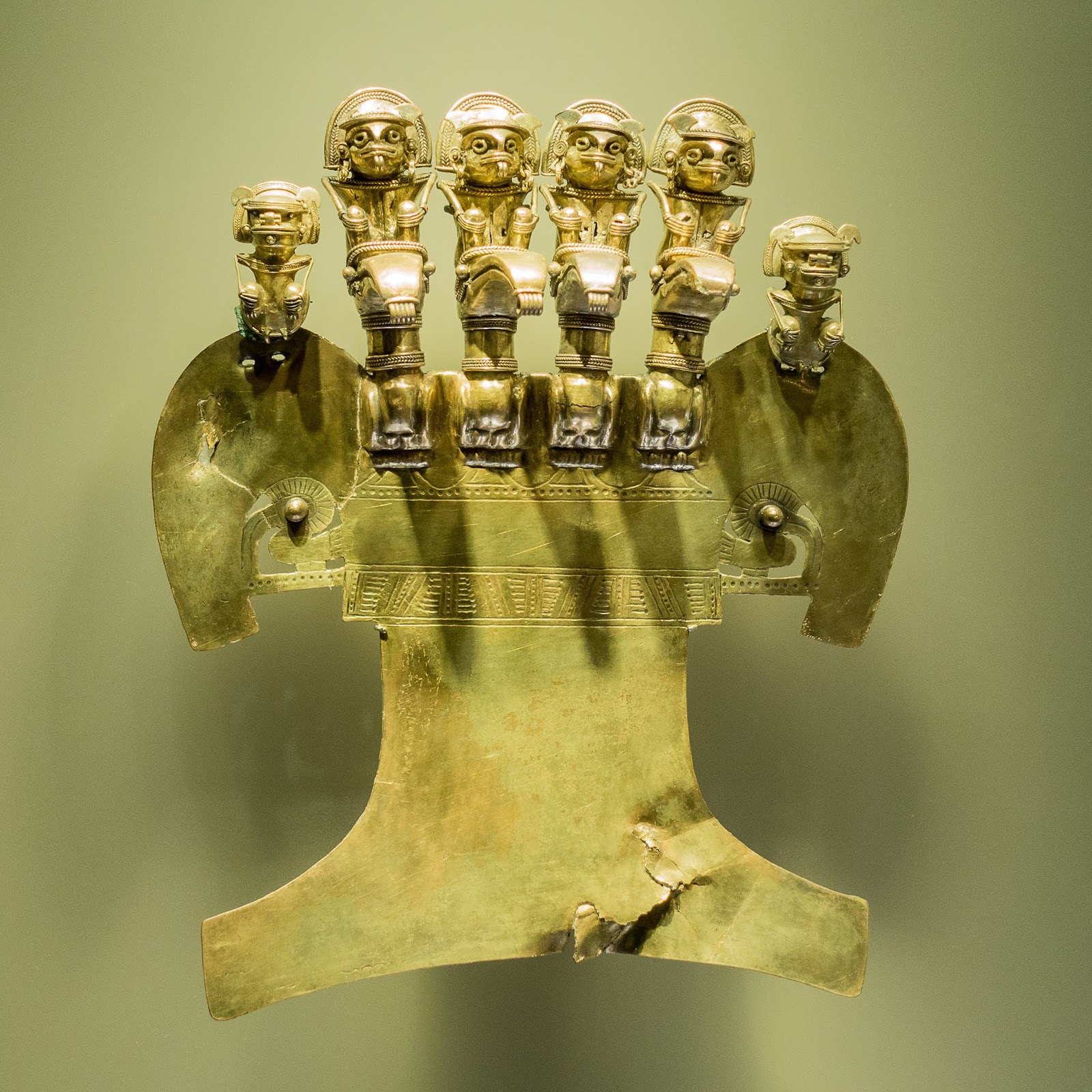
Later that day, we made our way back into the city to visit Bogota’s Gold Museum which to put it simply was unbelievable, as was the fact the Spanish didn’t get their hands on the many artefacts on display, some of them thousands of years old and very beautiful.

Some of the smaller but very detailed and very OLD gold exhibits in Bogota's gold museum
Whilst in Bogota, we became physically immersed in Colombia’s involvement in the World Cup, when they played England for a place in the finals. 

It seemed like TVs had popped up everywhere, in Cafes, out in the streets, inside the Gold Museum, the city coming almost to a standstill, even the police were absorbed by the game.

We had found a seat in a café near our accommodation, preferring to be in the crowd to experience the passion they have and there was plenty if it!  When Colombia drew level with England, forcing the game into extra time, the locals went absolutely wild.

Crowds had also formed in the streets watching TVs in many buildings, forcing traffic to a halt as the crowds yelled, cheered, screamed, hugged each other, some throwing soap suds all over themselves.
Just on of who knows how many excited crowds of Colombians watching THE game
Finally the time had come to leave Colombia, a country we had very much enjoyed, and especially the people and knowing we hadn’t spent enough time here.  

The people of Colombia rejected a referendum to confirm a peace deal with the FARC believing it too generous because the perpetrators of past deaths and violence wouldn’t be brought to justice.  

They also very recently voted out the President who brokered that peace deal, the new President yet to come into office and who had campaigned for a different deal with the FARC.

Why share all this?  It speaks a lot about the character and principles of the general Colombian population because at risk is a return to some of the hideous and unsafe past they have endured for years.

We wish them well for the future as Colombia has much to offer the world.
Colombia is a colourful and beautiful country
It was time to enter yet another country in South America so until we share our new experiences… go well!