Why...

Two mature aged people who love travelling and learning along the way... Our names are Rob (Robyn) & darian in the 60+ vintage of travellers keen to visit parts of the world which will stretch us mentally, physically and emotionally.

31 May 2022

To The Kimberley 2022

This is another trip within Australia primarily focussed on travelling via Queensland (Qld) and the Northern Territory (NT) to reach and explore the Kimberley region of the north west of Western Australia (WA). 


This time we were travelling with two good friends Gloria and Pete, enjoying their company until Broome, where we would part ways, they travelling their own route back into Qld and us continuing on within more remote parts of WA as we make our way home.


We departed on the 1st May and would be away for approximately 3 months.


The last time we were in the Kimberley was in 1990 and had been warned many things have likely changed since then.

Our entire trip route over the 3 months we were away covering ~16,000 kilometres

This post will cover our ‘To the Kimberley’ travel and as other blogs have previously covered much of our trip through Qld, will keep it simple using a few pictures and video whilst aiming for less words to describe where we went.

This map shows the main destinations we visited on our way to the Kimberley

With all the rain having fallen across Qld for many months now, the countryside was very lush with feed for cattle stations and greener than usual which was certainly very different for us.  We were also keen to share a few favourite locations with our friends who were embarking on their first long trip with a caravan.


Our first over night stop was at Chinchilla Weir to get us all into the groove via a campfire, some drinks and re-capping on our plan for the next few months.

Enjoying a campfire out our first stop at Chinchilla

A few days later we returned to Lara Wetlands near Barcaldine, Qld to enjoy a few days again admiring the location, doing our daily walks around the lake plus soaking in the hot spring.  Most of the usual camping areas were closed due to recent rains and minor flooding but it was still very enjoyable.

Some of the flooding impacting where we could set up
The sunsets/sunrises are always great at Lara Wetlands
Gloria & Pete loved the hot spring

Corella Dam located half way between Cloncurry and Mt Isa is massive and very popular with like minded travellers because you simply drive around its perimeter on any of the dirt tracks, pick somewhere to set up and settle in.  


Some people literally stay here for months and Gloria & Pete soon understood why.  We found a peninsula to camp on for just one night and we were soon a little surrounded.

We set up right next to the water
Small section of the dam... just find a nice place & settle in for awhile

By now you may be getting a feel that we were moving along reasonably quickly with multiple one night stops and you would be correct.  Our travel itinerary timing has been determined by some crucial bookings made once we arrive in the Kimberley, more on those in the next post.


Between us we had planned a few locations where we would stay multiple nights either to re-stock or simply enjoy a special location.


Mt Isa was a ‘restocking’ city, not just for food but in our case to have our 4th covid jab and vote for the coming Federal Election. We had a few minor technical issues to sort out as did the others before venturing further on.

These pop up in lots of places including toilet bowls
Last stop before crossing the border into the Northern Territory was next to a billabong (large waterhole in a river bed) outside of Camooweal.  We had heard about this location during previous trips but none of us had ever visited it, in fact this was the furthest our friends had been north of Brisbane.  It certainly lived up to expectations with plenty of water, trees and green grass.

No jumbucks at this Camooweal billabong
Enjoying the peace and good conversations

The Northern Territory (NT) is a sparsely populated part of Australia and has the reputation for enjoying a more laid back, irreverent and ‘she’ll be right’ bush style of life and it wasn’t long before we walked into it… welcome to the Daly Waters Hotel!

One of a few welcome 'signs' to the Daly Waters Hotel
We are early in the usual season for tourists travelling to the NT, but it was already very busy, so we made a point of reaching this pub by 1pm to ensure we could get into the camping area adjoining it and luckily we did, because they were turning people away by 4pm.

Located 589 km south-east of Darwin and 916 km north of Alice Springs on the Stuart Highway, this pub was built in 1930, so its a long way from nowhere to go for a drink.

The owner of the hotel with his friends
Very novel men's toilets

The whole pub and surrounding area is quirky with its signs, toilets, the bar and very obviously a major stopping point for most people travelling up the Stuart Highway.  Our timing was good because it was the kick off night for their ‘beef & barra’ dinner.

Enjoying our 'beef & barra' with LOTS of other people

They have their own unique philosophy in the NT
Another very popular stop is the small town of Mataranka, renowned for decades because of the hot springs travellers like to soak in.  Over the years, the main springs have become very commercial and the naturalness of the original springs consumed by concrete paths and stone walls around the pools.
Original Mataranka pools now more commercial

Whilst visiting the original pool, we spent much more time enjoying the nearby but smaller and more natural warm waters of Bitter Springs, a short walk from our caravan park.  The water was clear and warm with the ability for us to enter at one end of the springs, slowly drift downstream amongst trees before exiting to repeat this relaxing cycle.

More natural and rustic Bitter Springs pool

It was a good opportunity to take video of the experience which can be watched clicking on the link below.


CLICK HERE to watch video of Bitter Springs


Kakadu is well known and famous worldwide so naturally we headed that way, staying for a few days in Jabiru, using this as a base to visit many of Kakadu’s attractions, not all of which had reopened after the recent wet season.


To see things in Kakadu involves quite a lot of driving within this huge National Park, so we focussed on a few destinations kicking off with a visit to Cahill Crossing, the natural and tidal boundary between Kakadu and indigenous owned Arnhem Land.  There are limited times to cross due to large tidal movements and the risks of being washed off the causeway.

Fishing for barra and needs to be crossed at low tide to enter Arneham Land

At high tide, it is also a popular place for fishermen trying to catch the elusive barramundi whilst the abundant crocodiles wait patiently to catch both fish and people.


Kakadu is famous for crocodiles of which there are plenty, along with lots of other wildlife as we observed during our Yellow Waters sunrise cruise. 

Patiently waiting for something to make a mistake


CLICK HERE to view more Yellow Waters wildlife photos


CLICK HERE to watch video of Kakadu


Indigenous history and culture are a major part of what Kakadu is all about and one of the best ways to experience this was with a visit to Ubirr Rock to admire ancient and very detailed rock art galleries before climbing up the rock to watch the sun setting over the vast wetlands spreading out in front of us.

Small example of the Ubirr Rock indigenous art

Beautiful view during sunset from Ubirr Rock
Another wonderful experience in Kakadu

After reaching the Stuart Highway we headed into Litchfield Nat. Park, to camp for a few days and with the goal of swimming at Wangi Falls to cool off from the constant 35+c heat.  Small problem being early in the season… the falls were closed due to strong currents as the wet season impacts diminish.

Plenty of water flowing at Wangi Falls but too much for swimming

There were alternatives however in the form of Florence Falls, reached by climbing down 100+ stairs to reach the large pool below the falls where we swam and sat beneath the plummeting water before climbing back up the stairs and visiting Buley Holes.

Very refreshing, especially when sitting underneath the falling water

Buley Holes is a series of pools formed in a creek as it flows downhill.  Some of the pools are small and shallow, others very large and deep and some small but at the bottom of small waterfalls over rocks.

Aaaah... lovely!

We found some holes in a small waterfall where we wallowed for awhile to again get some relief from the constant heat of the NT.


Katherine is the gateway west towards the Kimberley but not before doing a 2hr tour along the waterways of Katherine Gorge learning about the indigenous history and culture of this waterway.

Impressive sheer walls during Katherine Gorge boat tour
One of the boats used during the tour

We did a 2hr, two gorge tour up and down the gorges, stopping to both look at more rock art high up on the gorge wall and to walk between the gorges to take the next boat.


We were now heading west towards the border with Western Australia (WA) as the number of boab trees increased, the rivers got larger and the scenery changed as escarpment landscapes became more prominent.

You never know what you will see whilst driving remotely
There are only few small towns and roadhouses along this section of the journey and we made an overnight stop at Timber Creek to do some fishing in the crocodile filled and wide Victoria River.
We tried fishing without luck but not bad scenery though
From Timber Creek, the scenery as we drove towards the Western Australian border changes, becoming more impressive with even larger escarpments and with subtle changes in colour to more reddish hues forecasting we would soon be ‘In the Kimberley’, but more about that in the next post.

CLICK HERE to watch video of Litchfield, Katherine Gorge & Timber Creek


In the next post we will be 'In the Kimberley so until then... Go well!


16 February 2022

Heron Island Queensland

Getting to Heron Island involved a 5hr drive north of our home to Gladstone and an overnight stay to make the 9:30am ferry to the island  There is only a single trip to the island on certain days.

Trip route to Heron Island, Queensland, Australia

Trying to keep things succinct… a few quick facts about Heron Island:

  • there are now no herons on Heron Island but there are egrets.  There were reef herons in 1920’s
  • Heron is an islands or quay at the southern end of the Great Barrier Reef that started forming 6,000 years ago
  • is part Nat. Park, part resort, a bird & turtle sanctuary - no drones allowed
  • takes about 20 minutes to walk around island
  • resort started construction in 1970s so buildings and accom. are a bit tired but okay

General views of Heron Island - jetty and the bar
 It took 2hrs to get here with plenty of people using sick bags due to rough seas and we were straight into briefing on arrival about how things work, including rules when interacting with the wildlife, things like:
  • don’t touch the sharks or rays
  • stay away from the turtles laying eggs
  • don’t step on the baby turtles trying to reach the sea
  • stay away from turtle nests
  • don’t pick up any baby Noddy terns who have fallen out of nest etc etc. 
Rail - can fly but like running around on the ground
One of thousands of Noddy Terns

There are a variety of activities both free or paid for everyone to enjoy and we chose a bird walk, turtle hatchling walk and snorkeling on the outer reef.  Masks, snorkels and flippers are provided to each person per room at a cost, so it wasn’t long before we were in the ocean directly out of the front of our room for the next 5 nights.

The view directly out front from our room

At the resort there is a swimming pool, hardly used because of the beautiful aqua blue ocean surrounding the island, a bar, small store, restaurant, reception centre and marine centre.

The swimming pool with restaurant in the background

For the first 36hrs there were strong winds and infrequent rain squalls before finally abating, but it didn’t stop us walking around the island along the beach, exploring various tracks across the island, all the time being constantly accompanied by a range of birds, especially noddy terns in their thousands, the most numerous birds and most of them nesting.

Various walks we took around and through the island


We were always in the presence of birds
It took almost 48hrs to be in truely relaxed mode, slowing down even more and getting into a simple set of routines which included spending more time just observing the wildlife activity all around us.

Our goal(s) during this visit to Heron were:

  1. do a lot of snorkeling
  2. relax
  3. try to see some Green or Loggerhead turtles coming onto or leaving the beach
  4. see some baby turtles hatchling coming out of their nest and hopefully reaching the ocean

We managed to go snorkelling at least once a day but 2 times was more frequent, including venturing to the outer reef around the island.  The reef is not rich in colour but there are still all sorts of fish living within it.  People who went scuba diving told us the reef was more vibrant in the deeper waters they visited and even saw manta rays.

Shows the extent of the reef around Heron Island where outer reef tours can venture


Very quickly everyone learns there is an abundance of white and black tip sharks patrolling close to shore and most visitors became quite relaxed as they glided close past them whilst snorkeling.  They were on a mission but more on that shortly.

Visitor enjoying the close proximity of ever vigilant reef sharks


In the waters around the island live a lot of rays of various forms and we managed to see these during snorkelling under the jetty we landed at.


CLICK HERE for Snorkelling Under Jetty - Heron Island


Our other goal was to find turtles either arriving onto or leaving the beach and see turtle hatchlings leave their nest and head to the ocean.


Seeing hatchlings bursting out of their nest came first because you really need to be in the right place at the right time as they may emerge anywhere at anytime between sunrise and sunset.

Baby turtles digging their way out of their nest

CLICK HERE for Turtle Hatchlings Marching - Heron Island


It was very surprising to see them bursting out of one hole and next was how quickly they ‘flipper sprint’ to the ocean with it all being over within 10-15 minutes.  We had to be very careful not to step backwards on baby turtles because they are all over the place.


There are many predators scouring the island looking for these babies to eat, the first being the birds, especially seagulls.  We were encouraged by the island staff to do what we could to scare seagulls away from any baby turtles trying to reach the ocean.

Lots of predators looking for a quick feed during breeding season

Talked earlier about sharks big and small patrolling the shores because they are  also waiting for the babies to reach the ocean and during one episode we watched 20-30 baby turtles successfully reach the ocean and start swimming before the water ‘boiled’ as sharks attacked them in the shallows eating every one of them.


During the breeding season only 1 in 1,000 hatchlings will return to lay their own eggs.


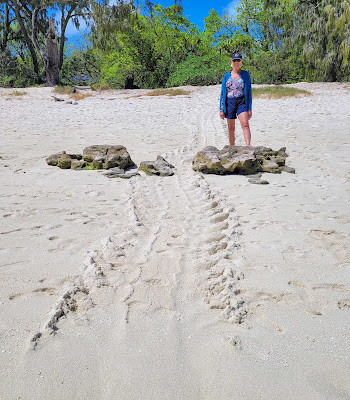
Adult green turtles take 25-50 years to reach reproductive maturity and return to the island where they were born, but only nest every 2-4 years and sometimes lay up to 9 nests per season.  As a result there were lots of turtle tracks on the beach each morning and new nest depressions.

Every morning we would find fresh turtle track on/off the island

Adult turtles prefer to arrive onto and leave the beach during high tide, reducing the distance to crawl to nesting locations.  We were lucky to have high tides happening around sunrise so it was early morning starts for us in our quest to find adult turtles.


We never actually saw any turtles coming onto the beach to nest but we did see them swimming close to shore.

Turtle swimming the shoreline either feeding on jellyfish
or waiting to come on land to breed

Over the course of a few mornings we found multiple adult turtles in the process of covering their eggs after laying by using their flippers and then return to the ocean to feed and rest.

It was fabulous to observe these magnificent animals.

Returning to the ocean to feed and rest

After finishing laying, she gently pushed sand back over the eggs using her rear flippers to cocoon them.  Next was the arduous task using her front flippers to push lots of sand backwards whilst slowly hauling herself forward.  

Green turtle covering her eggs

She also used her rear flippers to compress the sand and by the time she was finished, she had moved forward nearly 2 mtrs and had piled a 40cm layer of sand over her precious eggs.


It was such a privilege to be able to observe all of this?


CLICK HERE for Green Turtles Laying & Covering Eggs


We went to Heron Island with quite low expectations apart from the relaxation and snorkelling and we came away feeling very satisfied with what we had experienced.


With ‘living with covid’ now changing our capacity to get back into increasing travel activity, all being well (pun), there will be more to come from the Geripackers going forward.


CLICK HERE if interested in a few more Heron Island photos


Go well!