Why...

Two mature aged people who love travelling and learning along the way... Our names are Rob (Robyn) & darian in the 60+ vintage of travellers keen to visit parts of the world which will stretch us mentally, physically and emotionally.

6 March 2015

Tanzania Part 1. - Africa 2015

After 23+ hrs travelling from Australia via Abu Dhabi, then Nairobi and enjoying brief sights of the famous mountain, we finally landed into Kilimanjaro International Airport on 27th Jan, 2015.
Yep... the maps are back!
We were met enthusiastically by Raymond with his beaming smile and words heard much over the next 14 days, “karibu sana!”, which in Tanzanian means ‘welcome very much’.  Raymond, a local from the nearby city Arusha, and our guide for the next 14 days, had taken only just a few seconds to start trying to teach us the local lingo.  After mutual introductions, we promptly headed off to Dibuti Lodge for much needed sleep.

Next morning, Raymond met us with his ever constant smile and enthusiasm to commence our first game drive through nearby Arusha National Park.  Raymond works for Bramwel Adventure Safaris, a local company we had booked directly with, to avoid all the middle people and used by our son and daughter in-law during their honeymoon a year ago.

Before going any further, as a reminder, you can click on an image within the blog to get a larger version then just look for the 'X' to close it again.

For the next 2 weeks, there would be just our guide Raymond, ourselves and his stretched 8 seater Landcruiser with its pop-up roof, to safely view wildlife, scenery and to capture the photos we may be after.  

We were therefore hoping to quickly establish a personal and trusting relationship with Raymond.


As we headed to the park, Raymond advised us we had come at a very good time because there were still very large zebra and wildebeest herds still migrating, a lot of young animals being born and as a consequence, quite a few predators around.  

Unfortunately due to the scare caused by Ebola, the number of visitors into East Africa had dropped very sharply despite the countries affected by it being 8,000 kms from where we were.  The good news with this though was that there would be significantly less other tourists in all the parks were going to visit.

The routine during our 2 weeks in mainland Tanzania was to do either a full days game drive or 2 game drives every day.  Most days had us in the car at 6:30am, returning to wherever our accommodation was by 6:30pm every night.  If doing a full days game drive, we would usually take lunch boxes with us prepared by the accommodation places, and if having a very early start, we would depart with both breaky and lunch boxes.

As part of our routine, every night we would wash the days clothes, load onto the laptop our photos from the day, delete any we didn’t want as a first review, re-charge camera batteries, create a separate back-up of photos on a portable hard drive and clean the dust from our camera gear.

If you are ever contemplating coming to Africa, be prepared for a LOT of dust, especially whilst doing game drives.  We had to constantly fully cover our cameras for protection, mind you, there was also plenty of dust in noses, ears, eyes, hair and on clothes, which also needed removing daily.

What will follow in a number of blog posts is a highlights summary of each of the parks we visited in terms of wildlife, accommodation and other interesting experiences, along with some photos… naturally, and the maps of where we actually went!

When it comes to any wildlife photos, they will be grouped by type eg. lions, hippos etc and accessed by links at the end of each blog post with a few inserted within the blog itself.  The simple reason for this is to enable you to only look at the animals you’re most interested in, so hope it works for you all.

So ‘twende’ or let’s go!


Arushu National Park
This was a great way to start, considering some slight jet lag we were dealing with.  It’s a small park in comparison to most others, but hasn’t any of the main predators in it like lions, leopard and hyena and this meant any animals we did see were quite relaxed.

Wildlife highlights here included the very beautiful black & white but shy Colobus monkeys with their long fluffy white tails.  Around one of the lakes in the park was an abundance of Lesser Pink Flamingoes constantly feeding and also some of my favourite birds, the African Fish Eagle.  There were numerous large and very confident ‘tribes’ of baboons, which would happily sit very close to our vehicle and the baby baboons kept us very amused with their playful antics.  There are also quite shy Blue Monkeys and plenty of zebra, giraffe and buffalo.
Colobus monkey
So we were off to a relaxed start for a full days drive in this small, almost ‘boutique’ park and it provided us with plenty of time for Raymond and us to get to know each other better.


Tarangire National Park
After leaving the lovely Dibuti Lodge, we stopped briefly in the frenetic city of Arusha (pop: 1.3M) to get some local currency before settling in to a 2.5 hour drive south west from Arusha to Tarangire Nat. Park.  We learned about Raymond’s wife and daughter Lisa, how he had become a guide, how he has been doing it for 9 years and more about Tanzania, its tribes and culture.

Reached the gate into Tarangire at 11:30am and typical of every day to follow, went straight into ‘game drive’ mode for the next 7 hours before reaching the lodge.  ‘Game drive’ mode simply means we pop up the roof, then Rob and I stand up in the back of the vehicle, cameras ready and everyone’s eyes scanning everywhere.

Tarangire is known for its large population of elephants and as promised by Raymond, there were plenty of baby elephants also.
aaah... the babies
We also had our first introduction to the infamous Tsetse flies, swarms of Tsetse flies of sleeping sickness fame, but thankfully though not that variety in this part of Africa.  We learnt very quickly that they sting when they bite, usually when either one of us was concentrating on photographing something.  What do you do, swat the fly or take the shot?

They are tough little buggers!  When you hit them they usually fell on the floor of the car, shook themselves off then flew away to attack again!  Some managed to find their way up my trouser leg which was a little disconcerting.  This is when we learnt you shouldn’t squeeze them to death either because when they bite, they engorge blood.  Hmmm… nice big blood stain on pants trouser leg to deal with later!

Raymond had warned us the day before to wear long trousers and use repellant but obviously we hadn’t used enough of the stuff.

We also learned over the next few days that Tsetse fly bites are like sand fly bites, they scream out to be itched and it took a few days for the bites to disappear.  Don’t be deterred by this, you just need to be prepared with the right clothes and quality repellant.  If using a Deet based one, be aware that Deet will melt plastic so be careful about hands and face when using cameras.  Apparently Picaridin repellent has less impact on cameras and is pretty good for malaria carrying mosquitoes, well so the stories go anyway.

Our lodge in Tarangire Nat. Park sits on a hill overlooking the plains and the Tarangire River.  It also had a very nice place to sit outdoors to admire the scenery below whilst enjoying a few ‘sundowners’ before dinner.  Will let you work out what that means.

spot the giraffe...
Whilst admiring the views and sundowners, the wildlife viewing continued with a giraffe less than 30 mtrs in front of us.  Above us hundreds of swallows were flying trying to catch insects in the rapidly darkening sky before a harrier swooped in and grabbed a swallow out of the sky, very impressive indeed.

very unhappy
Raymond met us at 6:00am with the ‘breaky boxes’ and a thermos already packed and we headed out just as the sun was starting to rise.  Wasn’t long before our first wildlife encounter, a somewhat grumpy and very large bull elephant.  He soon let us know his displeasure in interrupting him by throwing red dust up into the air with his trunk before lumbering towards our now stationary car.


Certainly got the adrenaline going as we stood there watching him through the pop up roof coming towards us, his huge tusks perfectly lined up with our stomachs.  Raymond just sat in his seat watching, his hand on the ignition and the car in gear.  The elephant casually changed direction passing closely behind us but when Raymond started the engine to leave, he rapidly swung around, ears out wide, trunk lifted and annoyed, moving again straight towards us.  
passing just behind us
We quickly ducked down and as we drove away, it took quite awhile for Raymond to stop his very hearty laughing as the sun rose rapidly into the sky.
Our first true bush sunrise
Over the next 3 days we averaged about 11 hours of game driving each day and apart from seeing lots of elephants and birds, our most notable sightings were:
  • our first sighting of 2 cheetahs lying resting in the shade on termite mounds.
  • 4 lions also resting in the shade, but up in trees, their paws dangling back towards the ground.  This got Raymond very excited to the point he got out his own camera and started taking photos.
  • we spotted a very large leopard climb up into a tree, so we enjoyed sitting underneath the tree with the leopard casually looking back down at us from 4-5 mtrs away.  We were told later at the lodge it was quite rare to see leopards in the daylight in Tanzania.
  • a lone lioness who walked right past our car, constantly making a low growling sound until her two young sub adult cubs ran excitedly out of the scrub very near us to meet her.
  • some bat eared foxes we had previously seen only at night, but these were very relaxed whilst watching us in daylight.


We were in Tarangire Nat. Park for 2 nights with game driving on the way in and then on the way out and it had a lot to look at and offer.  This park certainly got us into the daily game drive mode.


Ol Mesera Tented Camp
There are times during any trip when you meet fascinating people, as occurred during our overnight stay at Ol Mesera Tented Camp whilst transitioning from Tarangire Nat. Park to the next one.

our tented accommodation for the night
Barbara is the owner of this tented camp and runs it with the help of local Masai villagers.  She used to be an accountant in Slovenia, who met a Tanzanian studying medicine there, they fell in love, got married and she moved to Tanzania with him.

That all happened 45 years ago!  They had 3 children, 2 older girls, one who now lives in the USA and the other in Hobart.  The boy lives with the father after she asked for a divorce because he wanted more wives to give him more boys.

She shared with us what living in Tanzania over the last 45 years was like and it was simply fascinating and had us enthralled well into the night.  We were her only guests after almost all her visitors had been cancelled due to the ebola influence over the previous 4 months.

The other reason we were staying at Ol Mesera was to enable us to visit a real Masai village and learn more about this very proud tribe of people.  Our guide, a Masai who works for Barbara, was the son of the villages head man and our interpreter the grandson of Barbara.

As we made our 5 km walk across the barren plains in 37+C heat from Ol Mesera to the village, we learned via the grandson that the Masai:
  • steadfastly are retaining their culture by maintaining their traditional lifestyles.
  • can have multiple wives with the last wife making the house for the next wife.
  • each wife lives in their own home with their children and the husband lives in his own home.  He ‘visits’ each wife in turn.
  • went inside a Masai hut which is very small and with small slit windows.  It was pitch black as we entered and our eyes struggled to adjust, but our Masai guide could see perfectly.
  • they cook on open fires inside the hut and it gets very smokey but the smoke doesn’t seem to affect them.
  • boys get circumcised as part of their manhood ceremonies, but the age depends on the village elders and ability for family to pay the circumcisor.
  • its illegal now for women to be circumcised but some women still do it to themselves because in the past they were not allowed to get married till this had happened.  When they get married they receive a dowry.
  • Masai judge their wealth by first, how many cattle and then goats they own.  Masai kids from the age of 6 look after the herds during the day.
  • We were wearing shorts during our visit and as we walked around being shown through the village and meeting people, suddenly the hairs on my legs were being constantly pulled by the kids.  It was then we learned that the Masai have virtually no hair on their bodies.  Was very funny!
the head man in the Masai village with some of the many children
Also learned that the Masai no longer hunt wildlife, especially lions, something they are renowned for being very good at and was part of their coming of age traditions.  Men however do model their lives on male lions, which means they sleep a lot and wait for the women to get the food!

Overall, our time in and around Ol Mesera was a fascinating way to learn about various elements of Tanzanian history and culture.


Lake Manyara National Park
After leaving Ol Mesera and heading north towards to a very famous destination we were looking forward to visiting, a day couldn’t go by without some game driving, so we went wandering for almost 6 hours through Lake Manyara National Park.

This park consists of stacks of real jungle instead of the open grass plains of say Tarangire.  Also in the park is a large salty lake giraffes like to congregate around.


In the jungle there were again lots of baboons, vervet monkeys and blue monkeys.  The baboons move through the jungle in very large groups and when they do, all the other monkeys soon disappear.

"heh... don't run away... I'm interested in you!"
There were also numerous elephants rummaging within the jungle but occasionally they would  want to cross the dirt roads we were using.  So there were many times we just had to sit and wait till the elephant ‘roadblock’ decided to move on, albeit in their own sweet time.

It was Sunday and after the game drive we pushed on, stopping at a large busy town to buy more supplies of bottled water.  Whilst Raymond went off and collected the water, we watched all the beautifully dressed women and girls especially, almost parading around town.  Being Sunday meant it was their day for church and the reason they were all dressed up.

BUT we still had some distance to cover before reaching the gate and the inevitable bureaucratic process Raymond had to go through before we gained entry to our next park.  More importantly, we had to gain entry and reach another gate further inside the park on the side of the mountain by 6:00pm or risk being turned back.

As I said earlier, we have really been looking forward to visiting this very famous location but that will have to wait until the next post!
Overall context within Tanzania of game drives to date
More game drive detail - Arusha Nat. Park is in blue
We took a LOT of photos during our time in East Africa, especially since we had both the car and the guide just to ourselves.  

To try and make it a little easier for you we hope, we have selected 10-15 photos (sometimes more!!) per 'category' which you can select by clicking on its link.

A 'category' might be say be Elephants or Lions or Scenery etc., so if you're not interested in a specific 'category'... just don't click on its link!

The links will be inserted throughout each post covering the entire trip, starting with this one as you will see below.  A category will not be repeated in a later post!

We simply hope you enjoy the photos as much as we enjoyed taking them.


10 September 2014

Canada & USA Summary - 2014

The wanderings we enjoyed throughout Canada’s British Columbia &Yukon then Alaska are over and beginning to become part of our travel quilt of memories slowly built up over the years.  

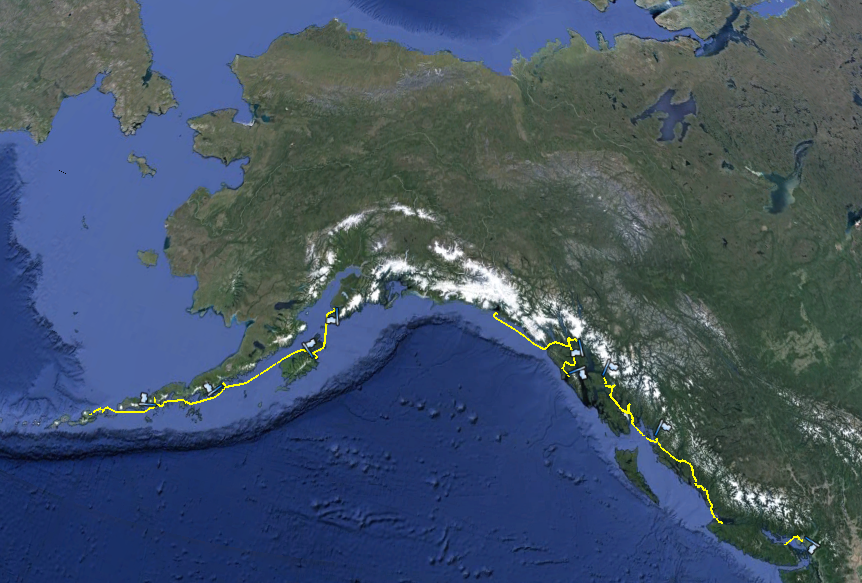
Now we can put the total map into perspective by way of the trip map below showing the total route we travelled irrespective of method of travel (red lines) and one which shows where we went on ferries alone (yellow lines).


map of entire trip (includes ferries, planes, Homer etc)
ferry routes taken during trip
We have found each trip presents learnings experienced either through the planning and/or doing stages.  Perhaps a few of these learnings may be useful to others, which is simply the reason for this final post of 2014.

The Planning Learnings
The planning phase for the latest trip kicked off in late October 2013 having decided on both the destinations and duration.  There we two core objectives we wanted to achieve during this trip:
  1. drive the entire length of the Alaska Highway (ALCAN)
  2. travel as much of the coast of Alaska and British Columbia by local ferries
Other destinations had to compliment the achievement of these goals, including the timing of ferry timetables especially.

ALL of the accommodation, ferry tickets, small boat tours, domestic airline tickets etc were booked online either well in advance due to seasonal realities, more on this later, or booked online whilst travelling.  We booked international flights through Flight Centre.
We did not experience a single issue with any of the bookings made.

For 1-2 hours most days until the planning was complete, we would scour the net with our PC hooked up to the TV to make it easier for both of us to see maps, pictures of accommodation, small tour details and to double check credit card details.  As a booking was made it was entered chronologically into a simple spreadsheet to capture key details like:
  • Activity description
  • date(s)
  • confirmation number/detail
  • contact details - name(s)/number/email
  • costs - total/currency, deposit paid, balance payment method (c’card or cash)
  • special requirements - waterproof gear required, lunch supplied etc
Later, selected columns of the spreadsheet were used to create an itinerary for our family, enabling them to know where/when we would be in most places and how to contact us.

Alaska, The Yukon and BC Canada have terrific publications we either viewed online, downloaded or had sent to us for free, to assist both our planning and selecting additional places to visit and/or things to do.  For this particular trip, we learned from friends to obtain ‘the bible’ if wandering up the Alaska Highway and ferry system called ‘The Milepost’, a truly invaluable publication.

We were obviously planning to drive the Alaska Highway one-way and our preference to do this in something like ‘Homer’ quickly fell into place after searching the net and learning there were a number of companies offering one-way rentals.  RV rental companies need extra vehicles waiting in Anchorage during summer due to the demand from people who take cruise ships from Seattle/Vancouver north up the inside passage and then want to drive back by RV.

Catherine, our daughter in-law, put us onto a credit card called ’28 Degrees’ (Mastercard by GE Money) which has no annual fees and only charges the currency rate at the time of any purchase compared to many other credit cards where you are charged additional transaction fees and/or currency conversion fees.  This card both worked everywhere and also proved invaluable.

Now for some specific learnings, in no particular order, out of the planning phase:
  • for Alaska, make sure you book early.  Alaska has a short summer season and many things book out very quickly.
  • Alaska Marine Highway:
    • seemingly convoluted web site BUT persevere, it will make sense and gets easier.
    • on some legs, ferries travel daily, others don’t’ so be careful if trying to link legs as we did working your way up/down the coast.
    • if travelling overnight and you want a cabin, book early as they do fill very fast.
    • you can take own food onto ferries and cook using supplied microwaves.
  • Hotel and motel prices climb very steeply in Alaska when their summer arrives which is why we stayed in more B&Bs whose prices were more reasonable.
  • Rental vehicle insurance.  In the USA especially, you must have some sort of insurance to cover the vehicle before they will let you take the vehicle.  They can use their personal car insurance to cover the vehicle in many cases.  We were always hit with some sort of LDW (Loss Damage Waiver) insurance so build that into your budget if renting.
  • If planning to drive more remote roads in either Alaska or Yukon, check with specific rental firms whether they allow it.  Some do, others don’t.
  • Timing.  If planning on heading into The Yukon or Alaska especially, get the timing right otherwise you may be slowed up by weather or things simply still being closed.  Going later in their summer however will increase costs.
  • If visiting Denali National Park in high season and camping, book online early as this place is very busy.  Check specific Denali weather forecasts before you arrive and book park bus trip for best possible weather.
  • Most accommodation will require a deposit using a credit card number before you will receive confirmation details.  You will need to decide how you will provide c’card details securely.
  • It rains a fair bit in that part of the world so take wet weather gear.
  • Plan clothing in layers to cope with changeable weather, blizzard one day, sunny the next.
  • The mozzies in the Yukon and Alaska are numerous and big - be prepared.
  • Additional RV rental costs.  Pay attention to extra costs when renting an RV.  Most have a daily mileage allowance, charge on an hourly basis when using the generator, charge extra if going on certain dirt roads eg. Top of the World Highway… cost like this.
  • Communication.  Think about how you want to communicate whilst over there, for example we bought a pre-paid AT&T sim when we arrived to give us voice and data capability in the USA.  Whilst it would work in Canada, it would be at a much greater cost but cheaper than using Aust. sim. We also got a Canadian sim whilst in Canada because of  the amount of time we were there.  They call it ‘Cell’ not Mobile by the way.
  • Weight.  Pay attention if using domestic airlines in any country, to the baggage allowances on each flight, because they are most likely to be different to those available on the international flights.  We almost got caught badly when flying down to Dutch Harbour on the small twin propellor plane.


The Doing Learnings
So once we got into the trip proper, again these are some learnings we had as our meanderings progressed:
  • You can’t pay much attention to weather forecasts except for the big cities (Anchorage etc) because Alaska and the Yukon have ‘micro-climates’.  Micro-climates are caused by the mountain ranges prevalent everywhere.
    Layers and having wet wether gear was the right advice
  • Internet.  Most but not all places had the internet BUT the internet away from the likes of the big cities could not always be relied on or there were download/upload restrictions.
    Our AT&T service didn’t always work in the more remote towns.
  • Buying a cheap GPS when you get to the USA will save many arguments and make driving on their roads a lot easier and less stressful.
  • Canadian and Alaska food prices were similar to Australia.
  • Most supermarkets have very good salad bars with very good choices and is a cheaper way of buying some meals if you are getting tired of eating out.
  • RV parks we thought, were relatively expensive when only staying a few nights for what you get.  If self sufficient (power, water etc), the State and National Parks were excellent.
  • If contemplating wandering along the Alaska Highway, there were plenty of places to buy fuel.
  • Except in the more remote locations, petrol (gas they call it) prices in both Alaska and Canada were cheaper than Australia.
  • We’re not usually B&B people but the B&Bs we used were very good and a lot of fun.
  • Crossing the borders between USA and Canada were generally uneventful but you will be asked lots of questions about whether you are carrying food, weapons, length of stay, reason for visit and so on.
  • The coastal ferries were good fun as were the people on them.  Those people noy in cabins for overnight trips slept on floors, across seats, in tents on the top deck, anywhere they could stretch out and came prepared for this.
  • Beware the cinnamon buns!


So that’s it for 2014 and we hope you have enjoyed some aspects of vicariously travelling along with us.  Will try hard to write less next time.

At this stage, our planning for 2015 is progressing well but will leave all this for next year, presuming nothing gets in the way for what we have in mind.

Thank you and keep having fun!


22 August 2014

Alaska to Canada - 2014

It was nice to be on a longer ferry trip this time as the map below shows, from Petersburg to Prince Rupert because it gives you time to  get into the lazy rhythm of this type of travelling, especially on the older ferries like the MV Taku.  Throughout the ship you can hear the slow melodic ka-thump of the motors and after a short while the sound becomes a pleasant part of the experience.
After leaving the ferry we had to clear Canadian Customs for what will be our last time before taking a taxi to our B&B in a part of Prince Rupert called Cow Bay.  We had heard mixed reviews of Prince Rupert from fellow wanderers and most of them not overly complimentary and after driving through the main part of town, we could understand.

our B&B - Prince Rupert
Cow Bay however was very pleasant indeed as was the Waterfront B&B we stayed in. We were lucky enough to have a spacious room with views out to the ocean.  The property is a little quirky, looking slightly like a lighthouse, in fact you climb up into the tower to have breakfast, everyone sitting around a large table and sharing stories.  Mary, the owner, was a delight in terms of not only the large breakfasts but her peaceful and warm interactions with everyone.

All around Cow Bay, the older part of Prince Rupert, were old little coffee shops, a great Japanese restaurant we went to twice and a great pub sitting out over the water.  Right next to the B&B is the boat harbour for the fishing fleet, so you could watch all the comings and goings, including watching fish being cleaned that were caught by tourists .

Prince Rupert was where I had planned to go fishing… BUT… discovered it was almost impossible at this time of the year.  The reason was pretty simple after visiting Harry’s On The Rocks and learning that each boat is chartered as a whole.  I could go fishing but would have to charter the whole boat at over $1,000!!  So serious fisherman come here and most other places in Alaska in groups and spread their costs that way.  At this time of the year with so many fish on the run into rivers, there were no boats free anyway.  Oh well.

sleeping humpback next to boat
We decided instead to go out on yet another whale watching tour, hopefully to see orca (killer whales) or more breaching humpbacks and because the price was right.  It was a public holiday so the Tasmanian designed catamaran was full with 100 people on board.  We didn’t see any orcas but did see humpbacks, managing to quietly sneak up next to one fast asleep, well asleep until the motors were started again.  Must admit, there are only so many humpback tails you can photograph, but did have a lady next to us crying with delight for about 15 minutes because she had finally seen whales up close, one of her lifelong ambitions… good on her.

Prince Rupert seems to us to be a place many people go to to go somewhere else, if you don’t happen to live there.  Don’t take this as a negative, Prince Rupert is one way of getting to coastal Alaska because you can drive to it from Canada then take a ferry northwards.  We rented a car for a day with the intention of heading towards a town called Terrace but were taken aback when we were told there were no unlimited ‘kms’, not even an initial allowance, we were going to be charged 35c per kilometre from the first one travelled.  Guess what, we didn’t get to Terrace.

We focussed instead closer to Prince Rupert and visited a nice lake, some tidal rapids and the old salmon cannery which ended up being very interesting.  The workers in the cannery back around the 1920’s had a tough time of it, either going deaf because of the loud equipment, getting arthritis due to having their hands in ice water for long periods, or risking lead poison.  Back in the early days, each can was soldered together using lead which meant the workers doing this were at risk as were all the end customers who ate the salmon afterwards.
real sunset at Prince Rupert
We ultimately enjoyed our time especially in and around Cow Bay before having to be at the BC (British Columbia) Ferries terminal at 5:30am to check in for our departure to Port Hardy.  It takes 16 hrs down the Canadian inside passage on a ferry which is both very modern and large, making the Alaska Marine Highway ferries look small.  We reserved seats at the very front with its large windows and with these reservations came checked larger luggage in the storage areas of the ferry so we didn’t have to look after them the whole time.

From the trip map below, you will see that the ferry truly does travel along an ‘inside passage’ staying well away from the open ocean most of time.  Unfortunately on the day we travelled, it was heavily overcast all day with occasional rain squalls blowing through, but despite this, the scenery was lovely.
it truly is an 'inside passage'
travelling down the 'inside passage'
Sitting one side of us was a lady from Ontario travelling with her husband who spent most of his time wandering around the ship whilst she tried to teach us everything she knew about where she lived and other parts of Canada she has been to.  On the other side were a Belgium couple on the final stages of their trip throughout Canada, who were also a delight to talk to and learn more about their country, including during dinner together.

We finally bid farewell to our new short term friends of 16 hours after arriving into Port Hardy, at 11.30pm.  Port Hardy is located at the very north of Vancouver Island.  They disappeared into the stomach of the ferry to collect cars, whilst we walked off and waited for our bags along with numerous others.  With all bags back with us, we boarded the old bright yellow school bus waiting to transport us to one of two hotels in town and a clean room, a good bed and a great nights sleep.

We were collected out the front of the hotel by our local bus next morning, well not really a bus, more like a shuttle van, for our trip southwards down the island, first to Campbell River where we transferred to another shuttle bus for the rest of the journey to Nanaimo located about half way down the island on the East coast.  

We planned to stay on Vancouver Island for 8 days and was a destination we had been looking forward to visiting for many years, after visiting one town at the southern end many years ago and having numerous people tell us how beautiful it is and beautiful it certainly is.  At the northern end of the island are very large snow capped mountains, dense forests of pine trees and delightful little towns we passed through like Telegraph Cove.

In Nanaimo we stayed in the Beach Estates Inn B&B run by Fran and Neil and what an interesting couple they are.  Fran bounded out to meet us, full of energy and enthusiasm to settle us in.  We met Neil next morning over breakfast after a great sleep in a really nice room.  

Neil is probably mid to late 60’s, has long hair below his shoulders and doesn’t shake hands, you greet by touching clenched fists together.  He also has a very inquiring mind, loves to make things and has strong opinions about most things.  They have been running their B&B for about 20 years, cook a great breakfast and for 6 months of the year live in their other home in Phoenix  We had some very lively and good conversation over breakfast before departing to collect our rental car for the next week.

Most people live on the east coast or at the bottom of the island, but there is a place we had heard a LOT about over on the west coast and that’s where we headed, then checked into the Tofino Travellers Guest House.  It was here some of the ‘Geripacker’ experiences kicked in as the term ‘guest house’ is really a slightly up market backpackers hostel.  We were in one of two private rooms and the rest of the rooms contain multiple bunks.  This place was full of young backpackers from all over the world and ‘mum & dad’… us.

breakfast table at the guest house - Tofino
Tofino, after a lazy walk around it in the sunshine, reminded us a little of Byron Bay in that there are numerous restaurants, coffee shops, arts & craft shops and surf shops, lots of surf shops.  During our stay in Tofino, we enjoyed the breakfast waffles each morning around one big table and chatting to all the young travellers who by now were quite relaxed with us.  We also explored the beaches, went for a walk amongst very large and old cedar trees on Meares Island and went for yet another bear watching trip, this time from a boat.
Rob and old growth cedar tree
The boat was an old ‘chugger’ which carries only 12 passengers with Mike as our skipper, a born and bred Tofino resident of 60+ years.  The black bears like to walk along the shoreline looking for crabs and it wasn’t long before we found them.  They had no fear of us at all and allowed us to come within 10 mtrs of them, so for us it was a very different experience.  We were no longer looking down on the bears from viewing positions, we were almost at eye level with them.  

The shores here are covered by bright green growth on the abundant rocks and it was the rocks the bears turned over with significant ease, no matter how large they were.  After watching them we certainly gained a significant appreciation and respect for the strength of bears.
looking for crabs
On our trip to and back from the bears, we spent most of our time talking to a young couple from Amsterdam who had been travelling throughout Canada with their two young kids and who have travelled extensively throughout the world already.  At one point whilst the husband and I were sitting chatting out on the front of the boat alone, I asked him, “what sort of job do you have that lets you travel so much?”.  He smiled and simply replied, “I’m in the marijuana business!”.  They employ 60 people and have warehouse distribution locations both in Holland and the USA.

It took us about 5 hours to drive from Tofino down to Victoria at the southern end of the island.  Victoria also happens to be the capital of British Columbia, not Vancouver as most people believe and we have visited here before.  It is a lovely city with that typical casual style of British Columbia.  Two things were on our agenda in Victoria, a visit to the Butchart Gardens and also our last chance to see orca.

We woke to pouring rain the day of the 3 hour tour out on the sea searching for orca, but it was meant to decline during the day and our boarding time was 1 pm.  Later as we walked to the docks, the rain had eased to a very light drizzle and right on time, we headed out to sea with about 30 others, many of them Aussies doing inside passage cruises to Alaska.  The sky was not looking too good and the crew informed us it would take around 40 mins before we were in the area they hoped to see some transient orcas.

Wildlife spotting is always a risk and you don’t always get to see what you’re after as it was this day and alas… no orcas!  By the time we had reached where the orcas should have been, the rain had started to fall again and out on the horizon, a wall of fog was slowly heading our way.

time for a rest and stretch on its back
We were however treated to the antics of a sole humpback whale.  We knew something was up when the skipper started yelling, “go, go, go” which could be heard above the engines and everyones chatter.  Then we saw what he was excited about, this whale,  lying on its back slapping both its huge fins onto the water.

The boat stopped and we all headed up onto the roof to watch, despite the now light but steady rainfall.  The whale rolled over about 100 mtrs away and we saw that familiar arch in its back then its tail disappearing into the depths.  That was it we thought.... gone!  The whale had different ideas.

Up it came, arched its back and fell back into the water with a huge splash.  A breach!  This whale was in a playful mood because it continued to breach or lie on its back slapping its fins for over an hour.  
Even better, it decided to come closer, even pulling off a breach about 20 mtrs directly in front of the boat.  An impressive sound of 40+ tonnes of whale smashing back down on the water.  It was a fantastic thing to photograph and the time soon came to put down the camera and watch the rest of this spectacle as the fog slowly swirled in around us.


There were just so many breaches and this is just one sequence near to our boat - click the link:


Fishermans Wharf - Victoria
The whale disappeared into the mist and we headed back to the dock where disembarked and headed to Fishermans Wharf, a set of floating food stores and homes of all shapes, sizes and colour.  We were still on a high after watching the humpback, but must admit to both being disappointed not to see orcas.  Maybe next time… somewhere else.  

Before leaving Victoria, we headed back out after dinner and when the sun had set to have a look at this lovely city at night and thankfully, the rain was finally gone.


Butchart Gardens
Our drive back to Nanaimo was via Sooke on the west coast, then to the Butchart Gardens, a place Rob had wanted to visit for many years and what a set up it was, with hundreds of visitors going through it by the time we arrived. These gardens were not only busy and beautiful, they are a tourist based money making machine.  

Before reaching Nanaimo, returning the car and settling back into Fran & Neil’s B&B, we visited 2-3 small towns along the coastline.  Vancouver Island is certainly bigger and more scenically diverse than we thought, but as beautiful as all those people we had met in the past had described.

trip map around Vancouver Island
ferry to Vancouver and then to Bill's home
We relaxed throughout our 90 min BC Ferry trip from Nanaimo on the island to Horseshoe Bay on the mainland where Bill, a Canadian and very good friend of almost 20 years was waiting.  

We hadn't seen Bill and his wife Charlyn for almost 8 years so were looking forward to catching up and staying with them for three nights before we flew back to Australia rather than doing a whole lot of touristy things.  The three days with them was great, combined with a lot of fun, good catch up conversation, including meeting their family one very entertaining evening during our stay.  We also appreciated their hospitality and look forward we hope, to returning it one day.

The time had come however to head back to Australia after 16 weeks of being on the road, sea and air during our meanderings.  After our farewells to Bill and Charlyn, we flew out of Vancouver to Los Angeles then boarded our Qantas flight for a nice, "g'day" welcome, our flight back home and a bundy.  It has been a very enjoyable albeit a very looong trip.

This is a poem or saying that was written up on the guest house wall in Tofino that resonated with us relative to travelling:

     This is it
     This is really it
     This is all there is
     And it’s perfect as it is

     There is nowhere to go but Here
     There is nothing here but Now
     There is nothing now but This

     And this is it
     This is really it
     This is all there is
     And it’s perfect as it is
     
     James Broughton


There will be a final summary post for this trip, including a few learning’s but in the meantime, if you want to see some additional photos… you know what to do:

CLICK HERE for more photos - Back into British Columbia 2014