Why...

Two mature aged people who love travelling and learning along the way... Our names are Rob (Robyn) & darian in the 60+ vintage of travellers keen to visit parts of the world which will stretch us mentally, physically and emotionally.

9 June 2016

Costa Rica Part 2. - 2016

Now I did warn you… a LOT happened in Costa Rica.

Green viper
So with the euphoria of quetzal sightings and zip-lining still surging through us, that day in Monteverde was not yet over because we booked ourselves on a night walk into the jungle.  

We joined other visitors making a group of around 12 of us to receive the guides briefing, before setting off and the big messages were, stay together and do not go off the track.  

Why… very simply… snakes, very poisonous snakes, especially in scrub near tracks or in trees.

Tarantula


Night walks or safaris can be very hit and miss having done them before, but tonight we were in for a real treat and it wasn’t very long before having to take turns peering into a hollow log, the legs of a tarantula beckoning us to come closer.

The deeper we walked into the jungle, more wildlife kept appearing in the form of a toucan sleeping above us, a scorpion glowing under the glare of ultra violet light, fireflies flittering all around us, tiny frogs with red eyes trying to hide and a coiled green viper in a tree above us as the guide had warned.  
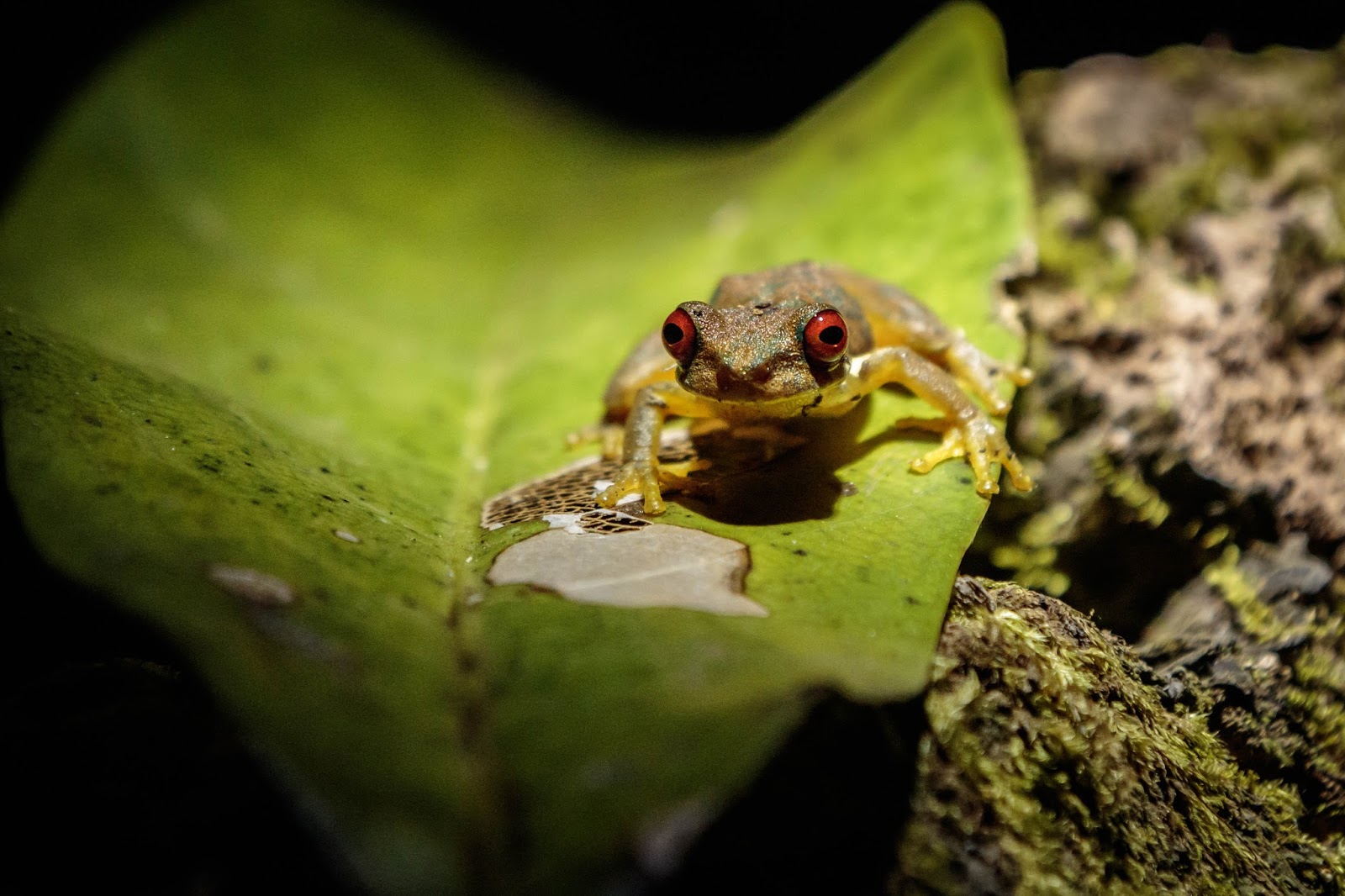
Red eyed frog
As we progressed, we also watched a coati hunting for food using its long noise on a large fallen tree, but then came the coup de gras high above us.

It was first hard to spot amongst the tree branches and then we were surprised at how quickly it moved but we soon learned why.  

It was a 3 toed sloth and a mother at that, because occasionally on her chest we could spot her baby sloth peering into the darkness.  What a delight!
3 toed sloth and baby
Even with limited rest after the previous nights wildlife walk, at 6:00am we were collected by our privately hired local guide to head back into the rainforest looking for more quetzals.  

With the sun having just risen, we quietly walked down a path, the guide pointing out a few small common birds when suddenly he cocked his head to one side, a weird noise grabbing his attention. 

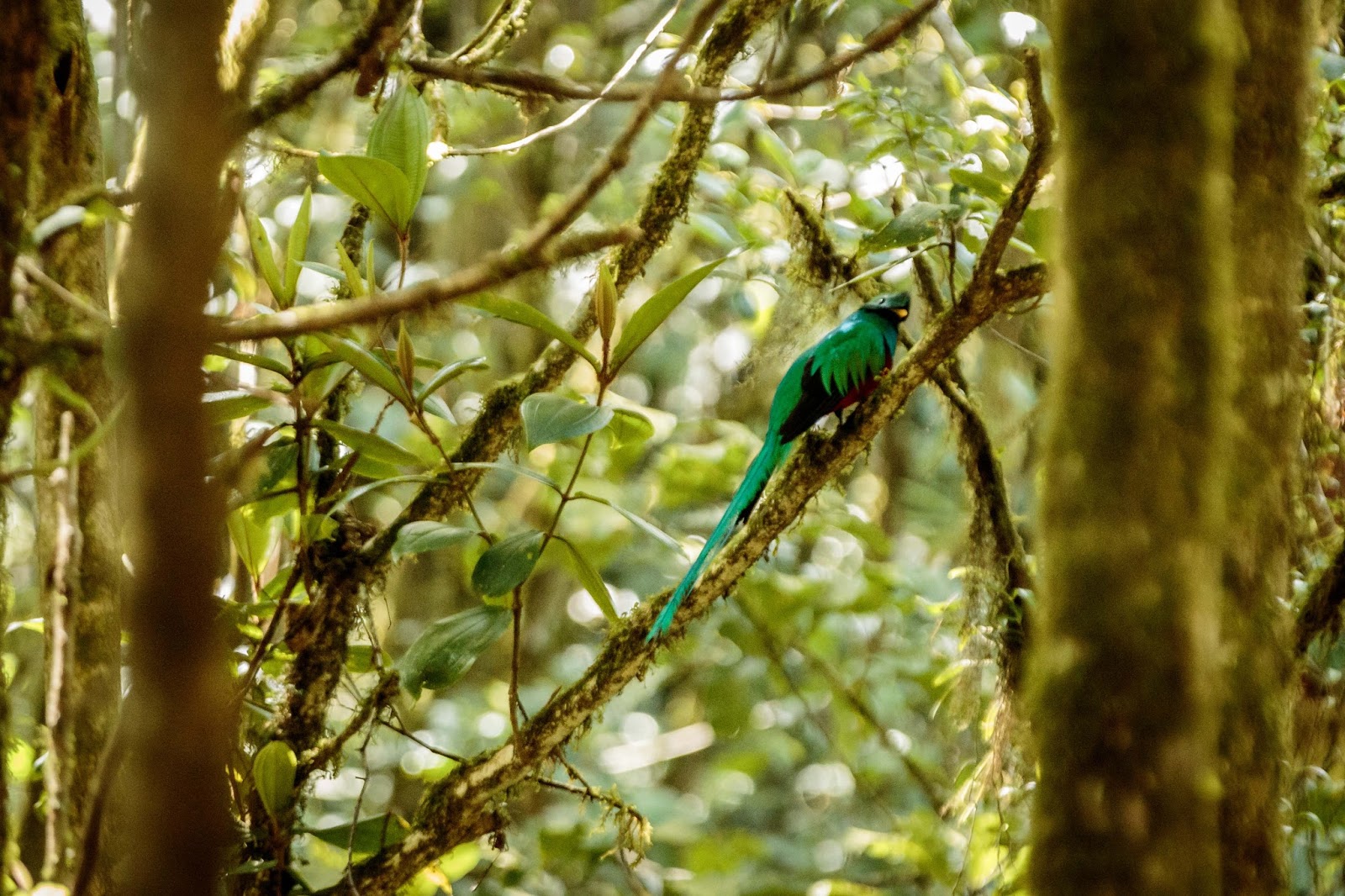
“We are going to have to run, seriously, we have to run NOW!” and with that he took off down the path.  Run… who said anything about running and then we saw it, another quetzal male and yep… it wasn’t long after, we spotted this glorious birds mate, sitting quietly in another tree, both of them calmly looking down at their excited observers, us.  

Then they were off, weaving their way amongst the trees and were gone… wow!

The rest of the day was used to simply chill out before again being picked up for our transfer to Quepos in the Puntarenas district on the west coast of Costa Rica.  We were to stay for a few days and visit the coastal Manuel Antonio National Park.  Our hotel here was located not far from the beach, so it wasn’t long before we were all enjoying a swim in the Pacific Ocean.
Manuel Antonio National Park
It was obvious when we reached the park’s entry gate next morning, we were yet again in for a new experience, a national park filled with people, lots and lots of people and most of them not overly interested in wildlife.  

Our guide explained that because of the parks location next to beautiful beaches and with the need for constant funding to maintain all the parks within Costa Rica, people pay to enter the park to reach a stunning beach located well inside it.
Locals enjoying the beach inside Manuel Antonio National Park
We joined a few hundred people walking through what was quite a beautiful area, us looking for wildlife, the others looking for the beach and surprised when they saw some wildlife.
Basilisk lizard
We did see some worthwhile animals like more lizards, a snake and another sloth, this time a 2 toed sloth watching over its baby curled up in a nearby tree.
2 toed sloth & baby
Also for the first time back near our hotel, we also observed the diminutive squirrel monkey, a new species for us.
Squirrel monkey
With the heat and humidity constantly sapping our energy, the rest of the day we joined hundreds of others swimming or resting under the shade of the palms on the beach near the hotel.
Beach in front of hotel at Quepos
Las Bolas - perfect spheres
Our transfer next morning was fast, not in terms of the time taken, but for the speed we were travelling, south again along the massive Pan Pacific Highway, the same we also traversed in Mexico.  

There was one brief stop to look at one of the world’s great-unsolved archaeological mysteries, Las Bolas or almost perfectly round stone spheres, some weighing up to 15 tons.  

Two of the 300 existing were sitting in a park, their true makers and purpose unknown, but its thought they were created around 1,000 AD in the original quarry over 80kms away and it begs the question, how did they move them there.

We arrived at our pick up point in Sierpe for yet another boat ride and our driver quickly found the owner of this transfer service, who told us where to leave our bags to be loaded onto a large boat sporting 2 big outboards motors.  Soon there were at least 20 of us sitting on bench seats as we departed, not really knowing just what was in store for us.

Charging past another speeding boat at 77kph
Those outboard motors were good, as we sped past other smaller transfer boats at 77kph whilst weaving back and forth along snake like channels, which slowly widened as we progressed.  

An hour had passed when the skipper blabbered something in Spanish, which others obviously understood, because life jackets were rapidly being donned.  We followed suit but why put them on now?

The waves ahead soon provided the answer, as we charged headlong towards the mouth of what was now a river…  we were going out to sea!  The boat did gratefully slow down as the skipper skilfully picked his way through and around the breaking waves and once clear, our speed picked up for a bumpy ride down the coast.

So what location were we visiting this time?  Our destination was the 424km2 Corcovado National Park, a very important place because it is regarded as one of the most bio diverse regions in the world, with National Geographic labelling it as the ‘most biologically intense place on earth’.  Special indeed!
Corcovado is a lot harder to reach as you will soon understand, but more excitement was to come as we neared our destination for 4 nights, Rancho Corcovado, located in Drake Bay, named after that English pirate Francis Drake, who operated in this area.  We had got into the rhythm of this ride when our boat made a rapid turn towards the shore, now what was going on?  Some words were again mumbled in Spanish, two large bags retrieved from the storage area up front and 2 people behind us took off their life jackets then shoes and next rolled their pant legs up!

With the boat now very close to shore, it spun around in the waves pointing the nose back out to sea and then started reversing towards the open beach, a building visible in the trees and some people standing on the shoreline waiting.  There came a point where the boat could reverse no further for risk of either being beached or the motors digging into the sand.

The 2 people with backpacks now on and holding their shoes and anything else, stepped off the boat into the sea, the people who had been waiting on the beach grabbing their larger bags, lifting them onto their shoulders as everyone headed towards the beach, small waves rushing in around them.

The 2 Robs wading to shore
All 6 of us looked at each other with both a look of incredulity and the same thought… were we going to have to do the same and the simple answer was… yep!

Five minutes later, the boat again did its spin in the waves and reversed towards the shore as we rapidly removed life jackets, hiked pants up and put backpacks on as our luggage was also hauled out of storage.  

Geoff, Lorna & luggage coming to shore
Now whilst the waves and water wasn’t too deep, we did have to ‘launch’ ourselves off the back of the boat from a small platform as it bucked around in the waves.  

So the real challenge was not to step as the boat rose up in the surf, the risk being we would end up face down in the water, our cameras destined for a very salty wash.

We all made it off successfully, including our luggage being carried for us, and walked up towards Rancho Corcovado sitting in amongst the trees and palms, right on the edge of the beach, a truly stunning location.  We were greeted warmly by the manager and shown where we could wash the sand off our feet, before then being briefed on how everything works.  All our rooms were excellent, with views to the sea and very importantly, were air-conditioned.  We also discovered there was a local village up a hill behind us and that the beach was very safe to swim at.

Perhaps the photo below will provide some sense of what this wonderful location had to offer as we settled down for our first open air dinner.
Sunset over Drake Bay
Rob hanging on in choppy seas for 1.5hrs
Our reason for being here was to visit Corcovado Nat. Park, one of THE major destinations of the trip, so it was an early 5am start, introductions to the local guide, a quick breakfast, cameras ready and shoes off to wade to the small boat waiting for another beach landing/departure.  

After picking up 2 other passengers, again straight off the beach further down the coast, we headed out to sea for a very very bumpy 1.5hr trip along the coast before yet again picking our way through quite large waves for the now familiar ‘quick spin’ near the shore and stepping into the sea.
Dragging lunch off the boat after landing in Corcovado Nat. Park
There were about 40 -50 other tourists all trying to find a place to sit and get the sand wiped off feet and between toes before putting their shoes back on.  

We were the last group to leave, just our guide and the 6 of us, the first task being to walk 2kms to a Ranger Station to check in, before exploring this magnificent park properly. 


Crimson crested woodpecker
We had earlier asked our guide if there was any chance of seeing tapir during the visit, and as we walked along the bush path towards the check-in point, our guide asked us to wait a moment before he walked off to one side down another narrow path.  

We watched him in the distance and soon he returned saying, “ I have been looking for tapir in a favourite wallow they like to use”.

Suddenly out of the jungle walked a man wearing a khaki Ranger uniform, a gun on his hip, and some sort of badge on his shirt.  He walked straight to our guide, ignoring the rest of us and started yabbering to him in Spanish and a little distance behind him, appeared another man dressed in black, a machinegun held in front and wearing a cap with the word ‘Police’ on it!  What on earth was going on we thought.

As quickly as they had appeared, our guide solemnly informed us we had to immediately go to the Ranger Station and that we were in trouble.  In trouble… why were we in trouble.  So off we went in single file, the gun-toting Ranger in front with the machine gun armed policeman behind me at the back!

Outside the Ranger Station, the other tourists we had seen on the beach were all hanging around, some talking in a somewhat angry manner, our guide not sharing much with us.  “What is going on?” we asked another visitor.  “We think we’re all being expelled from the park!” she replied.  What!!!

All the guides had been called into a meeting with the Rangers, so it was up to the other tourists to explain what had happened.  It is apparently common practice for all the guides to detour off the main path from the beach on the way to the Ranger Station and look for tapirs.  However, the rules in the park as we now learned, are that everyone must stay on the main paths and not make detours down side paths.  We couldn’t even tell the difference between main and side paths.
Walking through Corcovado Nat. Park
The Rangers had unfortunately decided to have a blitz on this the same day we were visiting, something we found out later had never happened before in Costa Rica, and all the guides and the tourists were being immediately expelled.  

Our guide returned and explained the same thing and almost tried to blame us for asking him to find a tapir and we soon told him we had not asked him to break the rules, especially considering as his clients, we weren’t briefed on what any of the rules were anyway. 

With that, a few in our party found the Head Ranger and tried to argue they were punishing us for something the guides were doing.  It did not seem to compute in his mind that the guides should be punished in some way after the fact, for example, suspend them from being able to enter the park… but punish the visitors!!


It did not change the decision to expel everyone, he did however allow us to walk back to the beach along a longer path, but we needed to go immediately.  

It was very hot and humid and when added to the sheer annoyance we were all feeling, it wasn’t long before all of us were soaking in sweat.  We were able to see a little wildlife including spider monkeys and a deer on the way back, but our visit to this beautiful and very special place was over, with none of us ever likely to return.  Our sense of disappointment and frustration was palpable.
White tailed deer
Spider monkey hanging around
Back at the beach, with the tide now well out, we had to walk over exposed rocks to board the boat amongst the waves again.  Most of us left our shoes on to avoid getting cut and possibly infected feet and then our boat had to get out through now larger waves with long heaving swells behind them… quite eventful as we frequently lurched towards the sky and then banged down on the back of each wave.

Boarding a boat for trip to Isla del Cano
The following day we visited Isla del Cano, an island about 1hr directly in front of our accommodation, to enjoy the scenery on shore and 2 lengthy sessions of snorkelling on the reef.

There were colourful fish everywhere, a sea turtle deciding to pop up for a breath right in amongst the middle of us and admiring some reef sharks asleep on the bottom.

By now we were becoming quite relaxed about beach landings.
Beach on Isla del Cano
We also went for another night walk with a local guide from the village.  It started very comically, after having piled into the back of the ute, it refused to start, leading to a few of us having to push to jump start it.  We were again warned to stay together because we would be near water on our paths, the location being a favourite haunt of Costa Rica’s 2 most deadly snakes, the Bushmaster and the Fer-de-Lance neither of which confronted us.  Whilst we did see one harmless snake, some toads and frogs, there wasn’t much else but the hike was good.

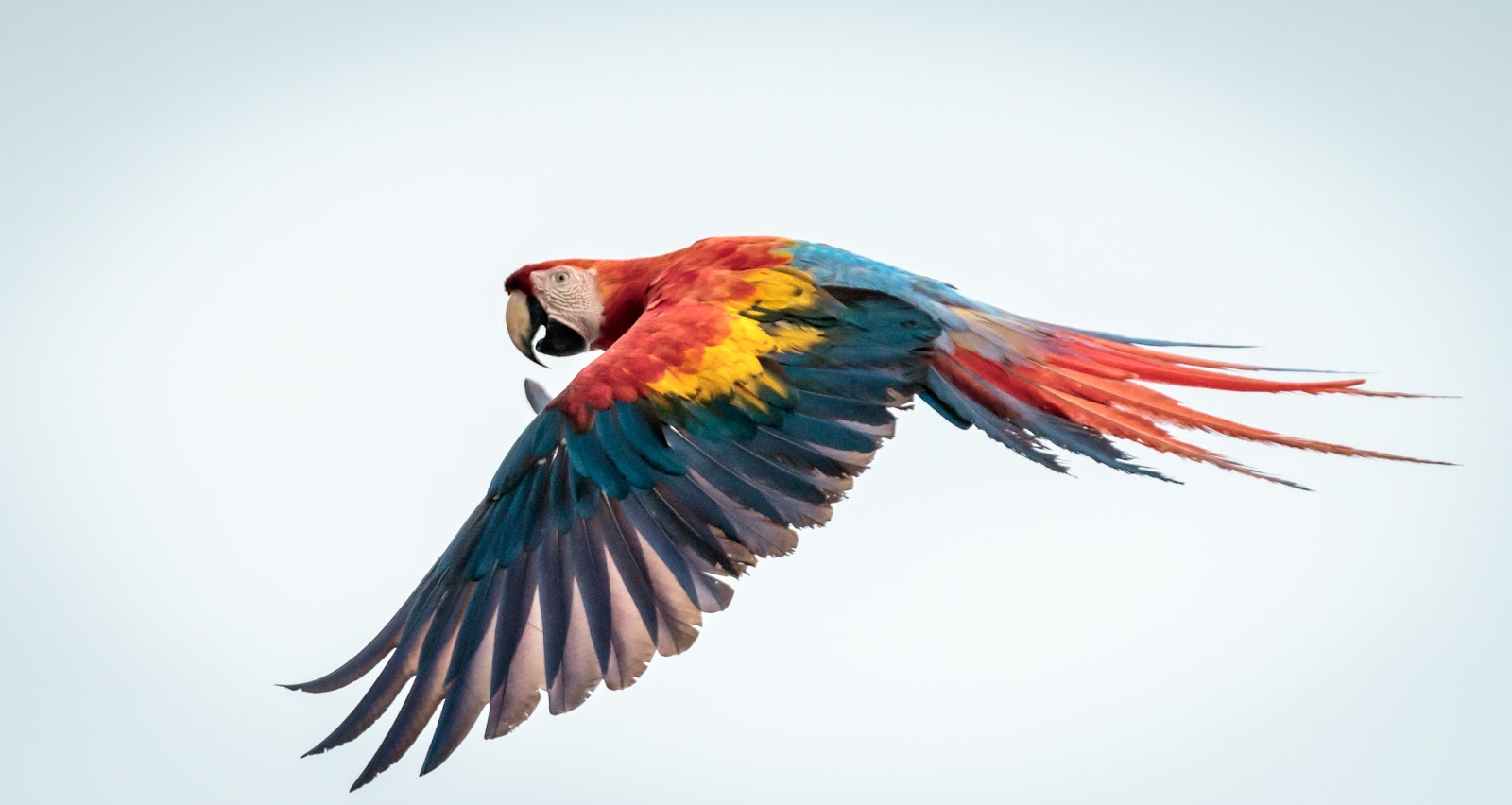
The last full day in Corcovado finally delivered a real treat for us in the form of multiple, lengthy and very noisy sightings of the fabulous scarlet macaws, local to the area.  The ones we saw were always in pairs, enjoying the ripe bounty on many fruit trees growing along the coastline.  We watched them for hours feeding in the trees above us but not overly concerned by our presence but their magnificent colours were fully on display when they flew from tree to tree.
Feeding macaw
Cavorting macaws
Our time in Corcovado was up as we made yet another beach departure and despite being expelled from the Park, would highly recommend this location for people looking for something very different.  The return journey back down the coast and through the mouth of the river was very benign this time as the sea was flat and soon we were disembarking and looking for our next driver for a trip to yet another border.
Last night on beach at Rancho Corcovado
Our itinerary notes advised us we would be dropped off, then cross the border and be picked up by a driver carrying an appropriate sign.  All sounds very simple doesn’t it and we wished the actual experience had been but that’s a story for next time.

So if you want to see a few extra final photos of Costa Rica then just click the link below.

CLICK HERE for more photos 2017 Costa Rica Part 2.

Go well!


6 June 2016

Costa Rica Part 1. - 2016

After leaving Guatemala City then flying over El Salvador and Nicaragua, we landed into San Jose, the capital of Costa Rica and waited in a long queue to clear Immigration.  It was in this queue we began to understand how popular Costa Rica is with Americans. They were everywhere!

Before we go any further, a few introductory comments about this post because having reached Costa Rica… we changed modes away from mainly history, culture and antiquities to concentrating on wildlife and outdoor experiences.

So let’s get started because a LOT happened and is the reason Costa Rica will be covered via 2 posts.  Costa Rica was a 15-day immersion and in that time we visited 5 National Parks or wildlife reserves, hence the title for this post.

Let me also apologise up front for some of the photos, which may look a little grainy or ‘soft’ caused by a technical fault with the main longer zoom lens we use, leading to over 95% of the photos taken being trashed on some days… unfortunately, but no excuses.

Here are 2 maps; the first shows Costa Rica in overall context with Guatemala and the 2nd with a closer view of the now familiar route map of our actual travels. 
Guatemala City to San Jose, Costa Rica
Our travels within Costa Rica
In this post however, will also use other maps to help orientate you to the location of the main Nat. Parks we visited within this beautiful country.

A little bit about Costa Rica first because it’s different to most other Central American countries.  Whilst it did come under Spanish rule, it received less attention from them because it had a very sparse indigenous population and a lack of gold and silver.  It gained sovereignty in 1847, had a brief but very bloody civil war in 1948 which lead to the permanent abolishment of its army in 1949, one of very few sovereign countries in the world without a standing army.
Locals enjoying the Caribbean coast beach

Costa Rica has a great reputation for being both a happy place along with having very progressive environmental policies, including having an actual plan for being carbon neutral by 2021.  

Tourism, especially eco-tourism, is a major focus for this rugged rain forested country with long sand rich beaches and coastlines on both the Caribbean and Pacific.  

Consequently, they have many National Parks and hence the reason we were visiting.

After an overnight stay in San Jose, we boarded a bus with ~40 other people and Diego, our guide, for the 2.5hr trip, first through the very rugged Braulio Carrillo Nat. Park before stopping to board a boat for another 1.5hr trip through narrow mangrove lined, but very shallow channels caused by drought.  Our destination was Laguna Lodge and our first park… Tortuguero National Park.
Laguna Lodge is located outside of this 312 km2 park, but visitors are not allowed to physically set foot on it, so ALL our visits within the park confines would be made on boats.  Accommodation in the Lodge was in comfortable but rustic, non-air-conditioned cabins, but the fan on the wall did get regular use due to the now constant humidity and heat. There was also a large, albeit warm swimming pool, that provided welcome respite.

Iguana on roof of dining area
Now is probably a good time to discuss Zika as in the virus, especially after leaving home with enough mosquito repellent to set up a shop somewhere.  

Here we were in the jungle but also surrounded by vast amounts of water, which lead to the inevitable question of our guide Diago, “are the many mosquitos around here?”  

“No mosquitoes, we are in drought,” he said as if he had answered this question thousands of times before which he probably has.  He was also right!

In, on and around the Lodge there was constant wildlife to observe, including our first views of many large prehistoric looking iguanas up in trees or walking around the lodge’s lawn areas, diminutive hummingbirds flitting amongst flowers in the gardens or the constant variety of other birds.

So during our stay we did 2 boat safaris into the park, both starting at 5:30am and Rob, Lorna, Geoff and myself, also spent almost 3 hours paddling kayaks along narrow but very serene waterways with a guide pointing things out to us.

Each boat held between 14-16 visitors, a driver and a guide, but was un-covered which meant by 7am we were beginning to slowly bake in the rapidly increasing heat, so everyone had plenty of water and sunscreen on. 


The sort of boats we used each morning
enjoying a very serene kayak
It was very different to other wildlife experiences as we slowly cruised along the waterways amongst thick surrounding jungle, stopping to observe the many water birds…
aaah... breakfast
various lizard species like the Jesus lizard because as we saw, it actually can run across water…
We got too close to this Jesus lizard...
...so it literally ran across the water to get away
howler monkeys whose screech can be heard kilometres away, and are regarded as the 2nd loudest animal on the planet, the first being the blue whale…
howler monkey making its presence felt
snakes, one swimming past us towards the shore...
and caimans, a small form of alligator to name but a few.  
a caiman trying to hide less then 1mtr away from the boat
Each water based safari lasted for ~3 hours and was a truly delightful experience, which hopefully the link to additional photos at the end of this post will attest to.

Passenger boat negotiating a deeper channel
The El Nino based drought whilst helping with mosquitos, did mean both our trip into and then out of Tortuguero, was tortuously slow.  

Everyone’s luggage was solely transferred using a smaller boat whilst the boat transferring just passengers, had to constantly ‘squirm’ its way along the channels and regularly lift the propeller to avoid jamming it in the mud beneath us.

Lorna had specifically asked Diego to try and find us a sloth to look at and on our way out of the park to the bus pick up berth, he delivered on his promise, pointing up into a tree on the side of the channel, a sloth, calmly hanging upside down peering back at us.
a 3 toed sloth just hanging around

It took us 4 hours to drive to the town of La Fortuna where we would base ourselves for a few days to visit Cano Negro Wildlife Reserve, located very close to the border with Nicaragua. 

Not too far in the distance we could also the classic cone shape of a large volcano… but more on that later.

We also had a free morning in La Fortuna, so we organised a taxi to take us to Mistico Arenal Hanging Bridges Park to walk the 3.2kms of track through the rainforest looking for wildlife, which included crossing 16 hanging bridges of varying lengths.

It was in this park we experienced our first rainfall for the trip, as the build up to the next wet season increased.

On the way to Mistico, we passed an accident, which had just happened, involving a car running off the wet road and down into an almost vertical ravine, the bloodied but okay driver being looked after by others who had stopped.  

On our return journey in the same taxi, a 4WD, we reached a roadblock at the same location as the police and a tow truck were now trying to extract the vehicle, without much success.  Every time the truck tried, the wrecked car tried to drag it back towards the ravine to join it!

We waited and waited, then a local in the crowd, came up with the idea of chaining the front of our taxi to the tow truck, so it could help pull the truck whilst it tried to pull the car out and back onto the road.  

Most of our little group stayed in the taxi as it pulled when the truck pulled, and it did make the difference when out popped the car.  Health and safety is a bit relaxed in most of these countries.

That same afternoon we did a hike up to an observation area overlooking the still active Arenal Volcano, the cone described earlier, which last erupted in 1998.  
Arenal Volcano
On July 29, 1968 the volcano also violently erupted and continued for several days, burying over 15kms2 under rocks, lava and ash, killing 87 people and burying 3 small villages – Tabacón, Pueblo Nuevo and San Luís.  The inhabitants who were killed are still entombed where they died.
The three towns destroyed were on the western side of the volcano, but a town by the name of El Borio on the east side was untouched and unharmed. After the volcano ceased to erupt, El Borio was renamed La Fortuna, the town we were staying in, which means "the fortunate".

bat line
It took 2.5hrs to drive to Cano Negro Wildlife Reserve where we boarded a boat to tour up and down the Frio River for almost 2hrs, again observing multiple birds, lizards, turtles and a new one for us, a row of very small bats lined vertically behind each other on a tree trunk.

There was plenty to look at yet again as our boat cruised slowly northwards through the very still waters, a small sign in Spanish next to a fence line being ignored along the way.  

It wasn’t until we had returned to La Fortuna and loaded our GPS plot for the day did we discover we had actually crossed the border into Nicaragua for .5kms.


The next park on our itinerary… Monteverde Cloud Forest, a very special destination for our small group, but to get to it proved an interesting journey. 

First we were picked up at our hotel in La Fortuna and transported the 15kms to Lake Arenal where we carried our bags down a rocky dirt track to a boat and travelled across the lake, climbing up another rocky dirt path to a small, non air-conditioned local bus, for the slow climb on a rough dirt road to Monteverde. 
Making our way down to boat for trip across Lake Arenal
Doesn’t sound too bad does it!  Well the distance from where we disembarked from the boat to Monteverde was ~23kms, it was a steep and bumpy dirt road, the temperature was 30+C, humidity 90+% but all the windows had to be open… no air-conditioning remember, which meant a lovely layer of dust settling all over us.  And how long did it take to cover ~23kms… a mere 2 hours.

Monteverde resides at an altitude of 1,440mtrs and as a result, was the coldest place we visited with temperatures ‘plunging’ to 15C at night, which was a nice relief, but it wasn’t the weather that made this location special, it was our quest to find Quetzals. 

“What are quetzals?” you might be asking.  They are a bird, but not just any bird because many regard them as perhaps one of the most beautiful birds in the world and they are now only found in humid highlands areas like Monteverde. 

Amongst the additional photos with the ‘Hola’ post is this photo of the headdress used by the Mayan ruler, Pacal the Great and it was made from the feathers of a lot of quetzals.
Pascal the Great's quetzal adorned headress
To try and achieve our quetzal goal, we first visited the 486 hectare Selvatura Park, which has as part of its attractions, treetop walkways both through and above the rainforest using a series of 8 suspension bridges, connected by trails totaling 3kms in length.  

The bridges were very impressive locations to view the ecosystem we were immersed within, and they range from 50mtrs to 170mtrs in length and are suspended from heights ranging from 12mtrs to 60mtrs above the jungle.

We had a guided tour along the walkways and it was from one of the trails we caught the first distant glimpse of our quarry, a beautiful male quetzal, and its 2 long colourful feathers streaming down from its back… what a truly stunning looking bird.  

Then as quickly as we saw it, it took off into the forest.  After walking a little further down the track from the others, I saw it again, this time directly above me, its long feathers floating in the breeze behind it as the camera went crazy.  Then it was gone, yet again!
During our 1 hour tour we saw or heard numerous other birds and admired the glorious scenery that stretched into the distance all around us, but Selvatura had yet another first for all of us if we were game, an activity it is renowned for being the best at in Costa Rica.

We all donned our special harnesses and hard hats, signed our lives away and had photos taken before climbing into a small van for a short drive higher into Selvatura Park to climb a ladder to have our first ever go at zip-lining!
...what have we done!!
So lets understand the experience we all actually completed, even though half of us were very uncomfortable with heights.  Our zip-line canopy ‘tour’ took nearly 3hrs to complete and consisted of walking to, then climbing onto platforms, being hooked up, before hurtling through the jungle to repeat this again, along 13 zip-lines. 

The shortest zip-line was 72mtrs and the 2 longest were 650mtrs and 1,000mtrs, yes you’re reading this correctly, 1km long!

For each zip-line, a pulley and other clips attach you to a thick cable.  Then you sit down, all your weight being taken up by the harness and sensitive ‘bits’ being squeezed in un-natural ways, cross your legs, lean backwards with one leather gloved hand loosely circling the cable behind you to stop any spinning.  


Rob disappearing into the jungle
The attendant at each tower then smiled… a knowing smile of what lay ahead for us and you’re off!

The first few zip-lines were a blur due to fear and trying not to spin, but soon most of us were able to look out and down at the scenery as it whizzed past, being brought back to reality as the task of stopping at the other end quickly loomed, usually in the motivational form of a large tree trunk.

The 2 longest zip-lines involved a different method; we had to go in pairs!  Rob was hooked up first and then I stepped behind her and was also connected to the cable before we both sat down and my feet were placed under Rob’s armpits for her to hang onto.  

We were then instructed to lie back before being released for our trip into the open air above the dense jungle below.

All hooked up and ready for the 1km zip-line
The 650mtrs zip-line went very well so were looking forward to the last and longest, the 1km monster hanging high across a very deep valley.  We gathered quite a lot of speed after being released, during the first part of this last run, the pulley making a very loud whirring sound as it ran along the cable above us.  

We were really enjoying the speed, the views, and the whole experience but as we sadly neared the end of the cable, that whirring sound and our speed rapidly diminished, joined by a concerning sagging sensation in the cable.

Then it happened!  About 40mtrs from the end we actually came to a stop, the 2 of us peacefully hanging on the cable above the jungle with nowhere to go.  Now what do we do?  Very quickly one of the attendants was hooked onto our cable and came rolling down to us, the sag in the cable making this very easy indeed. 

Till then I didn’t know this person could even speak English but he could when he said, “senor, you need to help”, help… help with what.  With both our hands respectively on the cable, we hauled ourselves hand over hand for what seemed like 400mtrs as Rob enjoyed a nice rest.  3 times we had to stop, catch our breath and recover, feeling totally stuffed when we were finally un-clipped from the cable for the last time.  It wasn’t very long though before a sense of euphoria took over after such an exhilarating total experience.

Whilst our day was not yet complete, this is probably a nice place to halt until Part 2. of Parks, Parks & more Parks.

Just click on the link below if you want to see a few more photos covering the first part of Costa Rica:


Till then… go well!