Why...

Two mature aged people who love travelling and learning along the way... Our names are Rob (Robyn) & darian in the 60+ vintage of travellers keen to visit parts of the world which will stretch us mentally, physically and emotionally.
Showing posts with label Juneau. Show all posts

9 August 2014

Sitka to Petersburg - Alaska 2014

this is real 'catch & release' fishing!


After our last visit to Salmon Creek in Juneau watching thousands of salmon trying to swim upstream to breed and catching one by hand next to the shore, we headed out to the terminal to catch our ferry to Sitka, Alaska as the trip map below shows.


MV Columbia was departing Juneau at 1:30am next morning (!!!), but fortunately for us, it arrived before midnight enabling us to board early and go straight to our cabin and bed.  When researching the trip and looking at ferry routes, this one stood out and motivated me to be up again at 6:30am next morning.  

Why… we were likely to be going through narrow channels and we did, sailing through one of the narrowest channels of the entire ferry network called Sergius Narrows in Peril Strait.  At around 100 mtrs wide and our ferry at 26 mtrs wide, there was only 74 mtrs to play with, exciting because the tidal currents which surge through this narrow opening makes manoeuvring interesting or so we were told by crew.

view from our balcony
We arrived early into the Sitka ferry terminal located about 8 kms out of town and tried to catch a taxi, but they were all busy due to cruise ships being in port, so we caught ‘The Ride,’ a $2 per trip community bus system which dropped us off almost out the front of our accommodation at the Cascade Inn.  The room was spacious and very comfortable, with a private balcony overlooking expansive views of the ocean, small islands and a dormant volcano in the distance, along with a constant stream of fishing boats passing by.  This place had a small kitchenette, so we dropped off our bags and went back to ‘The Ride’ bus stop for another trip, this time downtown to find essential groceries.

The area around Sitka was originally inhabited by the Tingit people for around 10,000 years before, and like many parts of Alaska the Russians arrived and settled in 1799.  There was a lot of tension between the two groups leading to a massacre of Russians by the Tingit in the early 1800’s.  By around 1808 however, the Russians were back in control after more fighting and continued their rule, until Alaska was sold to the USA and that transaction actually took place in Sitka. 

Sitka was then the capital of Alaska, until 1906 when it moved to Juneau and is one of the few larger Alaskan towns directly facing the open ocean and has a population of about 9,000.  It is also one of the nicest looking towns so far, with many very expensive looking houses in and around it, many with great views out to the ocean and enjoying westerly sunsets, if the sun is actually shining.

We got lucky, as after nearly 50 minutes still waiting for the next bus that Alaskan friendliness kicked in.  A small car with a largish indigenous bloke driving it, pulled over and asked us if we were okay and did we need a lift anywhere.  “Sure” we said, so Rob got in the back next to the child seat and I got in front.  Our good samaritan explained he had seen us earlier on his trip out of town to go looking for deer or brown bear, there was that bear word again, and saw us still waiting on his way back.  He was a very chatty person and decided to give us a mini tour around town before dropping us off in the centre.  “What’s your name?” I asked, “Billy Bob” came the reply, “welcome to Sitka and have a great time” soon followed as we shook hands and after thanking him, off he went.

During our time in this part of Alaska we have noticed that the sun doesn’t actually come out too often during what they all call ‘summer’, so when the sun does shine you must make the most of it and on our first day in Sitka, the sun was shining.  After a quick lunch we went searching for the Alaska Raptor Centre, a place which nurses injured raptors back to good health and releases as many as possible back into the wild.  They also have some resident raptors which can’t be released due to permanent injuries and it was amazing to see so many and photograph them at close quarters.
bald eagle up close - Alaska Raptor Centre
The weather forecast for the following day had it being sunny in the morning  and cloudy later, so again with the ‘use the sun’ principle in operation and having picked up a rental car, we headed out of town to find ‘Fortress Of The Bear’, this time a place which looks after orphaned bears and releases them if possible.  There were 3 very cute and young black bears along with 5 full grown brown bears, one weighing in at 500 kgs.  To watch the behaviour between each other whilst being very very close to such large animals especially when being fed, was quite something.  It was also a good opportunity to keep practicing our bear photography.
Fortress Of The Bears
Well the cloudy skies did return during the afternoon along with some light rain which continued into the following morning.  We had booked a wildlife tour with Captain Black Bart on his smallish boat.  We have enjoyed our trips out on smaller boats and with us were Rick & Robyn from Phoenix.  Captain Black Bart’s real name is Mitch and he was a loud talking entrepreneur who revelled in telling anyone who would listen, what his next set of plans were. 
yet another tail...
When booking this tour, we told Captain Black we were keen to go searching for whales, sea otters, orcas and visit St Lazaria Island, a bird sanctuary about 30 kms from Sitka.  There are no landings permitted on this island because it is used by numerous species of birds including puffins for nesting.  It was the puffins we were hoping to get a little closer to.


we got closer still... see link
The sea was amazingly calm and the light was pretty good for photography as Captain Black charged out into the bay looking for wildlife.  Captain Fred (Valdez) and Captain Black would make a great team, boy they sure both can talk.

Wasn’t long before we came upon a humpback who was reasonably relaxed with our presence, went looking unsuccessfully for brown bears along the coastline, found some large ‘rafts’ (groups) of sea otters bobbing around amongst kelp and did mange to get closer to some puffins.  
St Lazaria Island is very different indeed and obviously volcanic in origin.  Captain Black also shared some of his home smoked king salmon with us which was very tasty as the weather around us began deteriorating very quickly, so we turned back towards Sitka for a fairly bumpy trip.

Around 4 am next morning, Sitka shared another regular Alaskan experience.  The earth moved for us, the bed shook and the glass door opening onto the balcony rattled.  The sea also made noises Rob hadn’t heard before, all caused by a 4.7 size earthquake centred about 150 kms away from us.  Unfortunately I missed all the excitement, just slept through it and heard about it from Rob, then the owner of the Inn next morning, who also told us there had been a further 10 smaller aftershocks since the first shake.  

After our vibrant start to the day and the return of very steady rain, we drove to the end of both roads out of town, 22 kms in one direction and 13 kms the other, Sitka yet again is another Alaskan town which can only be reached by boat or plane.

We flew out of Sitka early the following morning as the next trip map shows, travelling via Juneau on a 20 min. flight, changing planes and then another 40 mins to reach Ketchikan where we were greeted by steady rain and dark cloudy skies.


Please note - the trip maps also include the touring (foot, car or boat) occurring in each town.
After collecting baggage we went outside looking for transport, a taxi in this case.  We then learnt how the Ketchikan Airport is different to any others we have been to, its on an island and Ketchikan is on another island.  Rather than catch a taxi, we first had to catch a small commuter ferry over to the other island and then catch a taxi into town.

Our accommodation,  a large one bedroom apartment located on top of a small business overlooking a small boat harbour and then the docks where the cruise ships berth, was a very nice surprise and really comfortable and whilst settling in enjoyed the large ‘Disney Wonder’ cruise ship berthing directly in front of us.
Disney cruise ship berthing out front
So how did Ketchikan start life, well it wasn’t because of the Russians and fur.  Ketchikan started life around 1883 when some bloke called Snow decided to build a salmon saltery which grew and then later others came to the region to start mining and also cutting timber.  With all the men around the place, Ketchikan developed a now famous and very active red light district on Creek and Stedman Street.  

Creek St is about 100 mtrs from where we’re staying on Stedman St, so we were right in the heart of all the former action and now historic area.  There is a bridge close by on Stedman St crossing Ketchikan Creek and the coho salmon run was definitely on whilst we were here as we watched people catching fish off the bridge every day.
Ketchikan is essentially located on a narrow strip of land looking over the passage between two islands with steep mountains directly behind it.  There are many buildings here either built up the sides of the mountains and there are numerous long and steep staircases with street names for the residents.  There are even roadways built on pylons on the side of the mountains but much of Ketchikan, including all of the downtown area sits on pylons over the ocean, such is the shortage of land for the city.  It all adds a unique character to Ketchikan.

liquid sunshine guage
The first few days here were a little limiting because it rained and rained and rained and rained.  Did I say it rained!!  Ketchikan is famous for its rain, in fact outside the visitors centre there is a ‘Liquid Sunshine’ gauge. In Alaska because of the wet weather and snow, you see LOTS of people wearing light brown gumboots everywhere, onto planes, around town, in restaurants and the locals call them ‘Alaskan sandles’.  There were a lot of them to be seen in Ketchikan where the annual rainfall average is around 4 mtrs and the locals we talked to simply said the rain we experienced was pretty normal, we just hope it doesn’t impact a tour we have booked to Anan Creek.
'Alaskan sandles' also in Petersburg
It was only drizzling rain with thick low cloud when we woke for our final day in Ketchikan and eventually made our way to the pick up point for our seaplane trip to Anan Creek, regarded as one of the better bear viewing locations in Alaska.  Michelle, our pilot and owner of the tour company advised us however that they couldn’t fly into Anan because of the low cloud cover and had contemplated cancelling altogether, but believed they could get us into another place called Taylors Cove and a viewing site on Margret Creek.  The other good news was that it would be cheaper due to the much shorter flying distance.

There were 5 of us in a tour group and we were all keen to give it a go, so off we went with a few bumps and one shriek from Rob along the way.  The coastal scenery around many of these towns is truly beautiful.  We were all briefed by our pistol and bear spray carrying guide on arrival, and about what to do if we came across a bear on the trail, and that we would only be seeing black bears, and away we went.  It was raining, not heavily but annoyingly if you were keen to take photos.


There is a viewing platform run by the Foresty Dept. and below us was a raging river due to all the recent rain and there was a big black bear standing on rocks near the water waiting to grab a large salmon, which it eventually managed, but soon took its catch under trees out of sight.  The lighting for taking photos was poor because of the thick clouds, a bear which is black and the rain.

Then we waited and watched and a bald eagle high up on a tree watched with us and we waited and waited and waited.  The plan had us staying here for about 3 hours so we hoped some more bears would turn up.  Waiting, waiting, waiting… no more bears, so we took photos of the solitary eagle.  After nearly 2 hours, things started to happen. First with one bear who arrived and very quickly caught a fish and proceeded to eat on the side of the bank.  Then the skies opened up and it teemed with rain!

After a while the rain eased and another bear came to the creek on our side directly below us and caught itself a salmon next to the fish ladder, started to devour it but again disappeared under a bush, maybe the bears don’t like the rain either.

The bear on the other side of the creek had almost finished its fish when another bear headed down the bank towards it and the first bear wasn’t very happy about it because it couldn’t make an easy escape.  With the rain still falling pretty heavily, the two bears sized each other up, bared their teeth at each other and even had a few quick swipes across the face with those large clawed paws.  Was fascinating to watch as they cautiously closed the distance between each other and eventually, the first bear was able to get away.

The new bear got on with the business of fishing and catching a fish then a few other bears came down to feed, one of them launching its head into the creek and causing a swarm of fish to madly swim away from the bank into deeper water but eventually it also caught a fish and ripped it to pieces and ate its fill.

Finally it was time to leave and we headed back down the track.  Rob was up near the front of the group and had a ‘pleasant’ surprise along with a few others when they came upon a bear sitting on a log right next to them.  Having realised there were people next to it,  the bear very very rapidly sprinted off into the forest and all I saw was the black backside as it disappeared.  Rob the bear whisperer, may have lost her touch, fortunately perhaps!

There had been other groups of people from other planes on the platform for shorter periods than us and when we reached the small jetty, two planes and the people were still there waiting to take off.  All the rain we experienced whilst watching the bears was from a change of weather, higher winds and even lower cloud.  Michelle had not been able to return to pick us up either, we instead would be returning to a point for collection by van in a jet boat, which we saw coming our way on the horizon.

We did have an interesting and very choppy ride back with plenty of spray hitting us from the small and very messy white caps all around us.  The trip back had many upsides though.  First, if we had managed to fly back, nobody would have enjoyed either the shrieks or words that would have come out of Rob’s mouth as the plane bounced around.  We also went past a nuclear submarine test facility moored in 400 mtrs of water.  Nobody knows when and if submarines are there because all the sound leakage testing is done below the surface.  On our trip back, we also travelled close to the shores of a few islands and seeing the coastal rainforest up close was a delight.

Our bear viewing tour, despite a very slow start and a lot of rain, had turned into quite a memorable experience indeed.

It was time to leave as yet another trip map shows and this one has us back on the ferry system, this time aboard the MV Matanuska for an overnight trip from Ketchikan to Petersburg, Alaska.  The ferry trip was very smooth because the route goes amongst islands and along relatively narrow channels and meant backtracking north a little.
Petersburg is located on Mitkof Island overlooking the Wrangell Narrows and began in the nineteenth century when a Peter Buschmann from Norway settled there, built a cannery, sawmill and docks and the settlement was named Petersburg after him.  There are only about 2,500 people living on the island and we came here because we thought it might be a little different because of it's mainly Norwegian versus Russian heritage.

It's a very neat town, different in that it wasn’t spread all over the place like many in Alaska are, requiring people to own cars, even if there is only an entire 50 kms of road in a town.  The other noticeable difference with the ‘neat’ description, there wasn’t a lot of junk in the yards of most of the houses, again something we have seen throughout Alaska especially.

our B&B
Our accommodation was in the Waterfront B&B, a very short walk from the ferry terminal, where we were joined by two American couples who had arrived on the same ferry as us.  Our room was right on the waterfront overlooking views of the terminal and mountains on the other side of the channel and it was very comfortable indeed with plenty of room.  Leroy, the owner of the B&B with Sammy, enjoys feeding the bald eagles which nest nearby, by leaving fish for them to swoop down and snatch when there aren’t too many people around.
bald eagle swoops above us at B&B
Our first day was spent walking and exploring the town after visiting the visitors centre.  We were immediately struck by the friendliness of the locals, being greeted constantly by “hello”, including from people walking on the opposite side of the road.  Others we either met on our side of the road or in a shop would quickly ask, “where are you from?”, then follow with multiple other questions, ask how we were enjoying Alaska then typically finish with, “welcome to Petersburg”.  Nice!

Whilst walking along the narrows heading out of town and admiring many of the timber homes either built over the water or with magnificent water views, spotted a familiar shape in the distance and they were heading our way… orca.  There were two of them quietly cruising down the narrows causing many of the locals to stop and also watch or complain bitterly about not having a camera with them.  Even though quite a distance from us, they are an animal with an amazing presence.
transient orca in the narrows
We had heard that the weather was meant to clear up for a bit so our next day was spent on yet another smallish boat, no not looking at glaciers, we were out looking for whales.  Petersburg is very near Frederick Sound, renowned for the large numbers of humpbacks that migrate into it from Hawaiian waters each year.

The boat is a purpose built jet boat with large viewing windows and seats 14 passengers but there were only 6 others out on the water with us.  It had stopped raining but at the start of our trip, there was a lot of fog hanging about.  One of the other passengers turned out to be a UK photographer who runs photography learning tours for small groups.  He had 6 clients heading out tomorrow with him, but this was his personal fun day.  He was very willing to share how he goes about taking wildlife photos, so I enjoyed picking his brains.
There are a lot of whales in this area at this time of year and as the fog lifted to a perfectly clear sunny sky and at times an almost perfectly flat ocean, we found the whales, at times though it seemed like they found us.  At one location we sat for over an hour just drifting, surrounded by 10-15 feeding whales at a time with a constant stream of them passing through.  One decided to check us out, re-surfacing without us knowing it was there, less than 3 metres directly next to us and scared the crap out of most of us.  Later in the day, after spending time watching a colony of sea lions, we found a pair of humpbacks briefly enjoying themselves breaching before continuing on with their feeding.

We always know when we have had a really good day by the number of photos we have taken and Rob cracked an all time record for her with over 800 photos to wade through at the end of the day after dinner.   I only had 400 odd to go through and cull!

Our last few days in Petersburg involved hiring a car for one day and driving to the end of both roads out of town, including an early evening visit to some rapids a local told us about.  The salmon run is on here as well, and bears are meant to come down to the rapids to feed.  We were also told that Petersburg has both black and brown bears, so with bear spray handy, we headed to the rapids.  It was a lovely setting with plenty of fish again trying to get upstream and on the opposite bank a good distance away was a black bear and cub.  They weren’t too fussed by our presence but another noise spooked her and she sprinted off back into the forest, cub close behind her.
At long last we also experienced something missing for many months… a sunset!  Behind Petersburg in the distance on the other side of Frederick Sound is a range of snow capped jagged mountains including one called Devils Thumb.  With the sun setting and near cloudless skies, it was an excellent opportunity to get photos of the fishing and seaplane harbour near town.  It was so nice to at long last see some ‘golden hour’ colours on scenery again.
Devils Thumb in background
But our time in Petersburg was at an end as we boarded the ferry MV Taku to now leave Alaska altogether and continue our southwards journey back into British Columbia, Canada.  As we pulled away from the dock, Leroy and two fellow American travellers we had hit it off with, waved us goodbye, which was a very nice way to depart.  
MV Taku in front of B&B
This trip shows using different colours our routes to each of the 3 towns.
Juneau to Sitka = blue
Sitka to Ketchikan = red
Ketchikan to Petersburg = green
Alaska is an amazing part of the USA, with fantastic scenery, laid back and very friendly people, very changeable weather and the constant feel of the great outdoors.  It is truly well worth a visit.

Just click the link(s) below to view any of the additional pictures:

CLICK HERE for more photos - Sitka <> Ketchikan <> Petersburg 2014


CLICK HERE for more photos - Humpback breaching, Petersburg 2014


22 July 2014

Yakutat & Juneau -Alaska 2014

During most trips we have, there is usually a place which creates lasting memories either because of some extraordinary experience, or it’s something we didn’t expect, or maybe something very amusing happens etc etc etc. 

Well… Yakutat is that place, so apologies up front, this post isn’t a short one.

The first of the trip maps below shows us leaving Anchorage for the last time and travelling roughly 590 kms via Cordova to a very small town called Yakutat in Alaska.

We wanted to experience something different in Alaska and from the very first step onto the plane for our flight to Yakutat, until we stepped onto the ferry to leave 3 days later, Yakutat simply overwhelmed us with experiences!!

After boarding, we learnt for the first time that we were on a milk run flight to Yakutat via a place called Cordova, Alaska.  When we landed there and some people disembarked, the rest of us had to stay onboard, the plane was a about 30% full.  One of the flight attendants having noticed our accents, wanted a chat whilst we waited, so we asked her, “what is there to do in Juneau?”.  

She recommended something, but then the person behind us offered an idea, then someone a few rows forward came up with something and before long, most of the people on board were joining in and even debating amongst themselves whether something was worth doing or not.  The waiting time flew by and we were already off to an interesting start to this leg of our trip.

As we walked across the tarmac after our landing into Yakutat, we were greeted by dense low cloud, drizzling rain and dim grey light.  We were staying at a place called Leonards Landing Lodge and Rochelle was waiting to take us there via one of 2 grocery stores to pick up basic supplies because our accommodation had cooking facilities and there aren’t many places to eat out in Yakutat. 

In the grocery store we met one of the locals who asked if we had been in Yakutat long and “are you here to fish?”.  She was very surprised with our reply, “no, we’re not fishing, just here to look around”.  Yakutat is usually a place people go to go fishing and is the smallest town in Alaska to be serviced by a daily jet service, mainly to freight peoples frozen fish back out.

So we climbed into some sort of old ‘yank tank’ with wide seats we immediately sank right down into, seat belts that either didn’t work of just weren’t there and headed off with about 5 of the 8 cylinders working.  Now Rochelle is fairly short and barely could see over the steering wheel but did manage to wave to every other driver and pedestrian we passed.  “It’s the done thing to wave around here” we were quietly advised by Rochelle, something we needed to remember when we collected our rental car.

Arriving at Leonards Landing Lodge, Rochelle parked the car not too far from where and what we would be staying in.  Now let me digress for a moment. The advertising on the web for our abode for the next 3 days reads a little like this - ‘this rustic cabin has been a favorite of smaller parties or those who prefer cozy privacy’ - and the words are accurate mind you, but  we wouldn’t quite describe it as a cabin, twas more like a shack and a fisherman's shack at that.
ours is the one on the right
Now before we go too far, we had a great time in our little shack with its fantastic harbour views from the large front windows or the occasional visiting fisherman who walked directly in front of them.  

The decor was sort of out of the late 1960’s early 70’s and sincerely, the beds were very comfortable and the rock which held the front door open when required was a great addition.  

We did have a stove with hotplates that all worked, a fridge although very rusty on the outside that worked fine on the inside, a good shower with a shower head on some sort of semi flexible hose which wobbled a bit when turned on, multi generational cutlery and everything any of us would have in a holiday shack.

our boat for glacier tour
Annette who runs the Lodge, had promised to arrange 2 things for us, and the first meant us waiting next morning at the end of their small jetty for Mark to turn up in his relatively small aluminium cabin fishing boat, which he did along with his daughter and partner.  

With introductions completed, we headed out into the bay, low grey clouds all around us and not looking too promising, not to go fishing but to go have an intimate look at Hubbard Glacier, considered the largest tidewater glacier in North America and intimate it turned out to be.

The cruise ships come in here to also visit Hubbard, and we saw one quietly departing whilst disappearing into the misty clouds.  Mark has been living here for over 20 years and usually runs fishing charters but about once a week or so, takes people to go see the glacier.  He obviously knows the area well because it was low tide when we left and there was a bit of weaving around local reefs to get out of the harbour.
Travelling time was a little under an hour and as we got closer to the now familiar blue white face of a glacier, the clouds started lifting almost as if scripted and out came the sun.  There was quite a bit of sea ice to manoeuvre through, Mark was very careful to avoid them, but even the smaller chunks did make a large bang when they hit the metal hull.  We detoured briefly towards the shore to have a closer look at a large colony of nesting birds with many proud parents showing off their chicks.
proud parents
Hubbard is both a large and a very active glacier, meaning is calves a lot, one of the reasons the cruise ships like to visit and it wasn’t long before we were watching very large chunks of ice sliding into the ocean with the usual very loud cracking sound.  Being so close to the water in such a small boat made everything so much larger.  To give you a sense of the scale of Hubbard, it is 122 kms long from its source, is about 10 kms wide and a 100+ m high face of ice to the sea surface.

Now I did say earlier that we had an intimate look at this glacier. First off we were closer than we had ever been before to any glacier and we were the only boat here and one of the reasons we were so close was because Mark had spotted something he hadn’t seen very often before, a river of fresh water flowing out of the bottom of Hubbard.  

river under the glacier
So we went into have a closer look, not so close that if the face calved in front of us that we were in danger, but close and when Mark put his engines in idle, the force of the gushing under glacier river water pushed us rapidly backwards.

2 or 3 times we went back to look at this river, all the time huge chunks of ice falling into the sea along the glacier’s face.  We felt small, so very very small.


Mark had decided to do something he has only done once before and we had noticed he was sizing something up before trying it, we just didn’t know what it was going to be.  Later back in Yakutat when we described what we did, most locals hadn’t experienced it either.

We went around the point!  
Bert Point (thanks Wikipedia)
At one end of the face of Hubbard, there is a narrow opening between the land and the ice and behind the opening is Russel Fjord.  Very infrequently, this opening gets blocked by ice and fresh water builds up behind it, causing flooding when it eventually bursts open again.  The point of land at the opening is called Bert Point and after much thought by Mark, around we went!

On the other side it was very peaceful, tall mountains and narrowing waterways disappearing into the distance.  As we cruised along, we also passed some back country campers sitting on the shore watching us who had kayaked in from the other end of the fjord.  The scenery was quite beautiful but we were running out of time and Mark had to get us back around the point.
view in fjord around the point
Remember earlier on in the post I mentioned it was low tide when we left Yakutat to come to Hubbard!  Well the tide had turned and they have very large tides around here which meant Mark had to negotiate his way back around the point into a very fast moving current rushing through the narrow opening into the fjord.  That was interesting enough, but the sea ice around the face of the glacier was also being pushed through the narrow opening with the current.

Some of the chunks of ice were bigger than the boat and the current was forcing many others down low to the surface of the water.  Mark manoeuvred his boat near the opening close to land in quieter water watching, waiting… deciding, then eventually gunned the motors.  It felt like we were in a pin ball machine, ducking and weaving around the ice in the water whilst keeping the power on to fight our way back against the river like current.  There was a lot of banging on the aluminium hull, a few interesting looks on many faces except Marks but it was quite a ride.

We spent a little more time near the glacier face admiring the many colours of blue and patterns within the face itself, before finally picking our way back through the sea ice and the trip back to Yakutat.  That was without doubt the best and most exciting glacier experience we have ever had.

sign on 'Fat Grandma's' coffee shop
Back at our shack was the rental car, an older model of Ford Explorer.  Annette’s organising was flawless but we had to go find the rental company and fill out the paperwork.  During the formal stuff, we were told to ignore the dash lights which might come on and off at times, make sure we always took the keys with us because occasionally it locks itself and so on, but it was a reliable vehicle.  We managed to wave at anyone who passed us and started to explore around Yakutat.

Yakutat is a very small community of 600-700 mainly indigenous people who are very welcoming and can only be reached by plane or boat.  Nobody locks their cars except ours which locks itself, because there is no way to drive out to anywhere anyway.  

There were a few places people insisted we had to see and the first was Harlequin Lake.  “When you reach the 4 ways intersection, go straight ahead and you’ll reach it” were the typical instructions.  Nobody told us what was there but insisted we had to go, so we did.

The bitumen road soon ended after the 4 ways intersection and we were onto dirt which normally doesn’t bother us, except in this car most of the shock absorbers were shot, so whenever we hit any size pothole, the car wanted to jerk to one side or other.  So now it felt like we were on a flat bob sled run trying to duck every hole in the road, which there were many.

50 kms later we came to the Dangerous River Bridge and the end of the road, guess this was it.  As we crossed the bridge, there were small chunks of ice floating in the river beneath us… interesting.  A small sign next to a narrow dirt path point towards the lake, so with bear spray handy we headed into the forest.  We had the spray with us because most people in Yakutat would at some stage mention the ‘bear’ word.

The weaving and at times muddy walk through the forest was terrific with all the delicate air plants hanging off the trees.  We were nervous though and started to notice someone had very recently been clearing the track, then we saw some tools and after about 1 km of walking, we saw our first glimpse of the lake… wow!
first view of Harlequin Lake
Before us was a lake filled with different sized and shaped icebergs, just stunning.  Before reaching the end of the trail and shore of the lake we saw more tools and finally saw a group of people sitting admiring the view also.  They were volunteers under the guidance of the Forestry Dept. clearing and cleaning up the trail.  We got on with taking photos, at the same time fighting off the mass of mozzies looking for fresh meat.  We had brought bear spray but not mozzie spray!

The volunteers soon started packing up and leaving, and it was then we saw one of them had a large gun.  With the ‘bear’ word still in mind, we rapidly decided we would follow them out but by the time we had taken our last photo, they were gone.  Our walk back to the car was a lot quicker than our more relaxed walk in and even when reaching the bridge, there were only two of them still there.

On the way back to our shack and with the morning clouds having lifted and the sun peaking out, “holy shit, look at that” popped out of Rob’s mouth.  Sitting in the distance off to one side of the road stood in full glory, the cone shape of Mount Saint Elias all 5,489 mtrs of it and to its right further back in the distance, Mount Logan in Canada at 5,959 mtrs.  Mt St Elias was closest at only 80 kms as the crow flies from Yakutat which meant these mountains also stood large and proud in view from the front of the shack.
Mount St Elias from the shack
We had a few other interesting experiences in Yakutat.  One was our visit to Canon Beach, so named because of the 4 WW II canons still lying there, but it wasn’t the canons which were fascinating, it was the long dark grey sandy beach strewn with huge dead trees, looking all the world like a massive tree graveyard.
tree graveyard
Before leaving Yakutat and boarding our ferry to Juneau, we had to fill the car with fuel, a simple task we thought, but this is Yakutat.  The bowsers are behind the ‘pub’ under a ramshackle roof and operated only by credit card and after going through that process and with the nozzle in the car, we waited for the fuel and waited and waited.  

The bowser was dispensing fuel at around 1c per second and after $2.89 of fuel, simply stopped.  Hmmm… what now?  Thankfully we were joined by a local who arrived in an original WW II jeep, fully renovated and with him were his two standard poodles sitting in the back.

He didn’t turn his little relic jeep off and tried also in vain to get fuel.  Being a local, he knew who to ring on his mobile, “Carol, there is no regular dispensing and there are some other folk here also trying to get fuel!” he stated.  “Probably out of regular” we heard Carol reply, “use marine petrol, its about the same” she said.  

Well jeep man tried the marine petrol pump, was soon filled and left.  Oh well, we’ll do the same thing, problem though is the nozzle for the marine petrol is much larger and wouldn’t fit into the tank opening on our car.

So there I was, pressing the marine pump nozzle as hard as i could over the opening to the cars fuel tank, hoping more would go in than not.  Took awhile but we filled the tank and added yet another memory to our Yakutat collection.  

After leaving the car near the ferry wharf with the keys still in it and waiting for the ferry to arrive, we met the head park ranger for the area who had spent time down in Tasmania and was very familiar with Australia.  We had a very funny conversation with Mike who casually also informed us that Yakutat has one of the highest concentrations of brown bears anywhere in Alaska.

Yakutat was Alaska in the raw and to us was like being in one of our small bush towns and we had really had a great and funny time here and one which will become part of our story telling folklore for years to come.

the ferry Kennicott
We boarded the Alaska Marine Highway’s ferry M/V Kennicott for an overnight trip to Juneau, the capital of Alaska and yet another town only accessible by plane or sea.  The trip was smooth and uneventful and if you work at it, you get to meet really interesting people doing extraordinary things.  

This trip map shows the route to and then around Juneau.


On the ferry was a man walking around with two cameras and familiar lenses intently taking photos.  You could tell he knew what he was doing and later in the trip, I went and had a chat with him.  

He was from France, spoke good english and yes, had been a professional photographer for a while but had a falling out with his clients in the media, also got divorced and was now on holidays.

“How long are you on holidays for?” I asked.  “Well I’m nearly at the end of it but it has been almost 3 years now” he replied.  He had bought a 1995 non electronic BMW motorcycle in France, had shipped it to Argentina and had been riding around South America up into the USA, Canada and now into Alaska for nearly 3 years and was on his way back down before shipping his bike back to France.  

We had a great little chat, compared photography equipment thoughts, with me doing more of the learning, and parted company as we neared port so that he could go get his bike ready.

Juneau has a population of about 30,000 and we stayed at Mike’s place, a B&B without one B, breakfast.  Mike, the owner, rents out a room and you stay as if you are one of the family, including on one night when we returned after a full day exploring, joining Mike’s surprise birthday party with his friends and kids everywhere.
Juneau
We picked up another rental car to drive to the end of each road in any direction heading out of town and to visit a number of Juneau’s sights.  Juneau is one of the ports all the cruise ships visit at the rate of at least 2-3 per day in season and occasionally there might be up to 6 ships in port at the same time.  

Juneau is popular with the ships because the city lets them re-fill with fresh water and because of the proximity of Mendenhall Glacier to the city, you can drive to it which we did.

For us it isn’t as spectacular as some we have seen and the crowds there wasn’t something we particularly enjoyed.  On our way back from the glacier, we stopped to take some photos of it but up along a creek with dead trees in the foreground.

I was back near the car when I heard Rob yelling, “bear, bear, bear!” and after swinging round, saw the large black bear crossing the road we were on and into the bush on the other side about 100 mtrs away.  Just another day in Alaska!
Mendenhall Glacier
Juneau sits picturesquely on Gastineau Channel with high mountains on both sides of it and from next to where the ships berth on the city side, you can catch the Mount Roberts Tramway to the top of them.  The ‘tramway’ is actually a cable car, a very steep cable car supported only by pylons at either end of it.  

We went up early in the day because the sun was actually out, something the locals were revelling in and enjoying because it’s fairly rare and the views were fabulous.  For the fare you can use the tramway as often as you like in a day, so we went back up that night to have dinner in the Tram Restaurant and to get some dusk photos.

One of our favourite places in Juneau was one we learned about by accident whilst picking up the rental car, Salmon Creek.  A local tour operator was picking up a van and whilst talking on her mobile to someone said, “will drop them off with the eagles”.  She noticed both of our ears prick up and told us if we go to Salmon Creek near the salmon hatchery there would be a lot of eagles to photograph.  
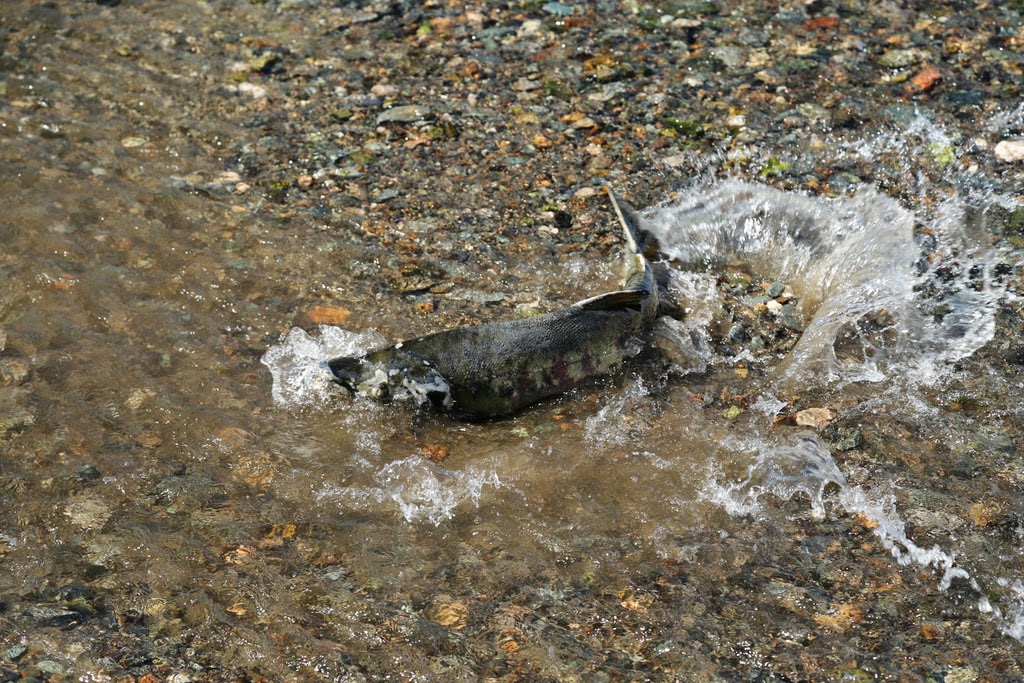
Salmon in Salmon Creek
There were and there were also thousands of salmon trying to get back into the hatchery where they were born to breed before dying. Whilst we watched the spectacle in front of us, one local reached down and picked a salmon up by the tail before letting it go.  

Numerous salmon were either dead or dying after laying their eggs and so the eagles and other birds come to this creek to feed on it all.

It was a good learning experience in terms of how the bald eagles react to people, how close you could get before they flew off and how they interacted with each other.  Am still hoping during this trip to get a photo of one swooping down to catch a fish with its talons but it wouldn’t happen here, too many fish for them to simply drag out of the water.  There was one juvenile eagle who whilst the tide was rapidly coming in around him, allowed me to get fairly close before it inevitably departed.

After driving to the end of every road leading to nowhere out of Juneau, it was again time to board yet another and different ferry to head further down the pan handle section of coast of Alaska.

If you want a look at more photos… there are 2 links below:

CLICK HERE for more photos - Yakutat & Juneau 2014


2014 - Hubbard Glacier Calving