Why...

Two mature aged people who love travelling and learning along the way... Our names are Rob (Robyn) & darian in the 60+ vintage of travellers keen to visit parts of the world which will stretch us mentally, physically and emotionally.

19 June 2018

Ecuador- Ecuadorian Andes - 2018

After flying into Guayaquil again from the Galapagos we were met by  Veronica, our driver guide for the next week. We travelled through the Ecuadorian Andes to Quito, the capital of Ecuador.

Veronica was straight into her job with a walking tour throughout Guayaquil, explaining the city’s history and showing us some of the old colonial style buildings.
Old colonial building in Guayaquil
Next morning as we drove out of town, we climbed towards our first encounter with the Andes and Veronica continued to share more detail about Ecuador, a country with ~70 volcanos and over half of them active. 

The country also has regular earthquakes each month and usually nothing to be concerned about she told us.

The map below shows the entire route we took, including the multiple stops along the way in smaller cities like Cuenca and Riobamba, but more on that later as we had to confront the Andes, that test coming on the first morning.
Our route to Quito through the Andes in Ecuador
It was quite a long climb into the mountains, cars with smaller engines struggling due to continuously reducing oxygen levels and after just a flew hours we stopped at a lookout called ‘Tres Cruces’ or Three Crosses.
Tres Cruces
This is a monument near Cajas National Park where many people have died from either altitude sickness or from being frozen to death when stranded during very cold overnight weather.

We had just reached our highest ever altitude at 4,161m (13,651ft) above sea level as our hearts pounded yearning for oxygen.  After enjoying the view across the very green Andes, the real test came when we entered Cajas National Park at 3,800m to do a 2hr hike along an undulating track.

Scenery in Cajas National Park
Veronica recommended we buy chocolate and Coca Cola to help reduce the risk of altitude sickness.  Well we seemed to cope fairly well, albeit with many rest breaks and panting a lot.  The scenery was very nice but no condors were spotted.

We stayed 2 nights in the city of Cuenca in a nice boutique hotel and really liked wandering the streets of this city because it had a great feel to it.  The entire city is UNESCO world heritage.
Centre of Cuenca at night
Next day involved a 1.5hrs drive from Cuenca, taking a short cut along a rough dirt track giving us a “natural massage” according to Veronica at least, past many small dairy farms.

Interestingly, here in The Andes, the farmers milk their cows by hand in the paddocks, collecting the milk in urns which are then emptied into a small milk tanker visiting each farm twice a day.  Could not begin to imagine these farmers’ lives during the wet season or winter.

The reason for the drive, was to visit the Ingapirca ruins, the largest known Inca ruins in Ecuador, which includes the Temple of the Sun. Veronica explained in much detail the history of these ruins involving the marrying of an Inca king to a local queen, then subsequently the death of the king at the hands of Spanish religious leaders for not denouncing his gods.
Part of the whats left of the Inca city of Ingapirica 
Ancient pathway leading to the Temple of the Sun
During the trip to and back from the ruins, we saw many local indigenous people, the women wearing brightly coloured dresses and also wearing some sort of Panama hat, so it was good to visit a renowned Panama hat factory to see how they are made.
Final products made in the panama hat family
A very early start and a 4hr drive had us moving closer to Quito, arriving in the town of Alausí, a whole pig cooking out front of one of the stores like we saw along the main road through the Andes in each small town. Ecuador’s version of fast food!
"Would you like somer clothes or perhaps some pork?"
If you don't like pork you could ry guinea pig... yum!
Alausí is the starting point of the Devil’s Nose Train, built from 1901 as part of the railway from Quito to Guayaquil but they had to find a way through the Andes.

The Devil's Nose Train at Alausi
This section of track, now named “the Devil’s Nose” because of the many deaths among the workers, estimated at 2,000 and the sheer difficulty of building it, connects the Alausí and Sibambe stations. 
The actual 'Devil's Nose' with railway tracks on it
The elevation of the track drops some 500 meters over the course of only twelve kms using a number of switchbacks being the only way to get the old trains up/down this section of track.
Actual switchbacks on the Devil's Nose
Some of the local indigenous maintenance crew
Well it certainly is a spectacular ride in the well refurbished original carriages, following a river along narrow but deep valleys on the mountain edge until negotiating the switchbacks before repeating the return journey.
Heading back through the valleys
After the train arrived back into Alausí, we were taken to enjoy lunch in a small indigenous village developing self-sufficient tourists venture, including growing the food used for the lunches.  Very warm friendly people.
Locals showing us their traditional dances
As we continued our journey, the ‘Sultan of the Andes’ came into view, otherwise known as the Chimborazo Volcano, standing at 6,268 mtrs, the tallest mountain in Ecuador and although its last eruption was ~1,400 yrs ago, is still considered active.
The Sultan of the Andes shows its considerable face
We also stopped to visit the oldest church in Ecuador known as the Balbanera Church built by the conquistadors in 1534, before arriving into Banos.  
Balbanera Church - stil in good shape after 483 years
Next morning we drove the original narrow single lane road following a deep gorge to take what is known as a ‘cable car’ ride across the gorge to a waterfall.
Our cable car for an exciting ride across a deep gorge
It actually really isn’t a cable car, it was more like an open cage we stood in whilst dangling above the gorge as the rain fell onto us. Proud that Rob did it despite her fear of heights.

Further on, we followed a mass of fast flowing water before it fell into the Devil’s Pot grotto to yet another waterfall whilst we stood right next to it as it plunged to valley below.  There is a walk of a suspension bridge and more stairs taking people down next to waterfall face, spray going everywhere.
The Devil's Plot
Spectacular place to stand on the edge of the waterfall
Our final overnight stay before reaching Quito involved driving through a grubby small community down dirt tracks, wondering where on earth we were going, until we turned through gate to be confronted by a long avenue of tall eucalyptus trees guiding us to the Hacienda La Cienega in the distance.
Hacienda La Cienega at the end of the avenue of eaucalypt trees
This was truly quite an amazing place, built in 1580 by the Spanish as a very large family home, with its own little church and very thick walls.
The hacienda's chapel


Various views of Hacienda La Cienega
It was also here we experienced a classic Ecuadorian dish... potato soup, not just plain potato, it comes with chunks of cheese and avocado in it along with a range of spices.  Rob was in 7th heaven and there were a few more of these consumed as the trip progressed,

It was now time to visit the ‘Throne of the Moon’; otherwise known as Cotapaxi Volcano at 5,987m and the highest active volcano in the world where we did a walk around a lake at 3,800m altitude, some puffing and rest breaks returning, but easier than previously.
The mighty Cotapaxi volcano

Hummingbird at 3,800 metres
There was some wildlife here including wild horses from the conquistador times, deer and humming birds.  A large part of Cotapaxi decided to show itself to us, which was very lucky because it doesn’t happen very often apparently.
Wild horses originally from the conquistador times
Finally we entered Quito for a few nights stay, allowing Veronica to take us on a tour around this city, the modern section having a very messy layout whilst the old colonial section built in grid form.
Partial view of Quito - original colonial section in the foreground
Central courtyard in original Spanish colonial building
Unbelievable totally gold covered church in Quito
Just north of Quito there is an attraction called the ‘Centre of the Earth’ where you can stand on the actual equator and then try a few experiments on and either side of it.
We saw water pouring out of a sink going straight down the plughole without rotating on the equator, then rotating in opposite directions a few metres either side of it.

We were asked to try walking along the equator with our arms out and eyes shut which was nigh on impossible and Rob successfully balanced a raw egg on the flat head of a nail… on the equator, a task impossible either side of it.
Rob successfully balances a raw egg on the actual equator
Finally we bade Veronica a fond farewell and awaited our next transfer to another location in Ecuador.
We enjoyed a pisco sour on rooftop bar in Quito on our last night
Go well!

12 June 2018

Ecuador - Galapagos - 2018

The first destination we booked over 12 months before leaving for South America was to the Galapagos Islands, and the rest of our trip was planned around it.

Our 2 sons and daughter in-laws, all of whom had already visited the Galapagos, were definite that we should visit and they helped us understand what was involved.

For example, we could do all land based ‘tours’ using water taxis between islands, or we could do a combination of boat and land or just boat. 

The challenge we also learned through them and subsequent research, was not all species of wildlife are found on all islands and for some, their presence is seasonal, like whales, as are breeding seasons.  

Additionally, water taxis could not take you to some of the furthest islands where some of the more iconic species are found.
The Galapagos Islands
We elected to spend 2 weeks, in fact 2 x 1 week tours back to back, on a boat called the Eden because it was the only one we found which visited all the key islands at a reasonable price, therefore giving us the best chance to see what we were most interested in.

Getting to the Galapagos first meant flying from Buenos Aires via Lima to a city called Guayaquil in Ecuador where we spent a night.
Buenos Aires via Lima to Guayaquil
After going through quite a strict process at Guayaquil Airport next morning, where our bags were scanned for any food products, and needing to purchase the Galapagos entry permit, we then flew to the island (isla) of San Cristobal on the Galapagos.
Takes 2hrs to fly from Guayaquil to Isla San Cristobal
There, sniffer dogs again checked our bags and mine was singled out for further inspection.  The dog had picked up some soil on the bottom of my sandals and after a quick spray of something; Luis, our guide on the Eden for the next 2 weeks, met us.

Even on the wharf whilst waiting to board we started watching wildlife, with frigate birds above, baby iguanas, or having to skirt around the sea lions.
Waiting on the wharf with a new friend
So over the next 2 weeks we travelled to many islands, each of which had either specific wildlife to be expected (hopefully) and other scenery.  Below is a table of the islands we visited and landed on, apart from Kicker Rock.
Over 2 weeks we visited islands using the following routes.
Week 1. (West to East) Route      ____________________
Week 2. (North to South) Route  ____________________
We also learned as soon as we arrived into San Cristobal that it was breeding season, so many of the birds were likely to be sitting on eggs if not looking after new borns and this extended to other species like iguanas.

Other wildlife were also likely to be courting for partners to mate with.
Blue footed booby courting dance
It was straight onto the boat, a quick induction before starting to meet the 13 other fellow travellers we would be with for week 1.  The maximum number of passengers on the Eden was 16, so we all got to know each other quickly.
The Eden
The Eden has a crew of 6 who were both good company but also keen to ensure we enjoyed ourselves and eat well… which we did.
Luis the guide on left with Eden's crew
What a great bunch of people the other travellers turned out to be with a good mix of younger and older.  Everyone was very respectful and helpful to each other plus getting on together extremely well.

With introductions to each other and lunch barely settled in everyone’s stomachs, the boat raised anchor and headed to Isla Lobos a short distance away.  Before reaching this island, Luis and crew were fitting us with snorkelling gear for our first activity.

Shortly after, there we were, making our way into the cool waters of the Galapagos, enjoying looking at many fish when suddenly, young, curious and very playful sea lions turned up to play with everyone!
VERY curious indeed
What an amazing experience to have them swimming around you, twisting and turning very close by, then coming up towards our faces and staring straight at us whilst blowing bubbles out of their mouths.
Sea lions playing with us
What a great way to start our time in the Galapagos and something neither of us will forget, especially as now we have a lot of underwater video of the experiences.

For the next 2 weeks we settled into a daily routine of multiple activities involving the use of ‘pangas’ (zodiacs) to either go on land, or do panga cruises or use them as a launching place for snorkelling.  A very loud ships bell signalled the start of each activity or meals.

No matter which island we visited there was always wildlife around or above you, quite often so close we had to be very careful not to step on them, including nesting birds, land or marine iguanas, lava lizards and sea lions.
Heron keeping Rob company behind her back
It constantly amazed us just how close we would be to the wildlife, including very small birds, which would normally fly away from us at home.  The rules were simple, stay at least 2m from the animals to ensure we neither hurt nor scared them.

It was also a surprise just how many people actually live on a selected number of the Galapagos Islands, something never seen or exposed in the multiple documentaries I’m sure we have all watched. For example, the population on Isla Santa Cruz is ~25,000.
Port area of Santa Cruz
Luis our guide who was born and lives on the Galapagos, whilst having a very keen sense of humour, also had a great knowledge of the flora and fauna of the islands we visited, plus their history. Nobody is allowed on land without a guide.
Luis behind Rob waiting for a panga to arrive
The 14 other passengers on the boat during week 2, were all very nice but due to language limitations, tended to break into groups during meals, the German & English speaking tables.

Our table being the English one, included some delightful couples from Holland and New Zealand who were a lot of fun indeed but we enjoyed everyone's company.

Our trips to land in the pangas were always eventful, after having donned life jackets and then either tackling a ‘dry’ landing onto steps cut into wet lava rocks then clambering up more rocks, or steps or a wet landing, which is as the name suggests, you step into the water, then go ashore.  
On a panga heading to shore
On one occasion whilst trying to board the pangas to return to ship, a group were almost washed off the rocky landing pier used when we arrived due to the rising tide and increased waves.

Our snorkelling activities were either commenced from the beach or a few off the side of the panga.  On some islands the water was reasonably warm, but others required renting a wetsuit for the day in order to stay comfortably in the water for an hour or so.  The Humboldt Current was returning already bringing cold water up from Antarctica.
All wearing wetsuits for the cool waters
All the snorkelling activities were very enjoyable and how couldn’t they be when you’re either swimming with seal lions on multiple occasions or...

penguins...
Galapagos penguins
sea turtles…
marine iguanas feeding underwater…
Marine iguana
sharks…
White tipped reef shark
Each day was very busy with at times 3-4 activities being undertaken like say 2x 1hr snorkelling activities and 2x 2hr walks on land and typically with 7am starts each day.

There were so many many other highlights during our time on the amazing Galapagos, but if we were to share but a few.

… blue footed boobies
Why they are called blue footed boob
Blue footed booby mum, baby and egg
...red footed boobies
Red footed booby
...nazca boobies
Nazca booby
...Galapagos hawks
The top predator on the Galapagos is the Galapagos Hawk
...short eared owl
Short eared owl is the 2nd top predator
...frigate birds
Frigate birds are great acrobatic hunters in the skies
...land iguanas
There are multiple species of land iguanas
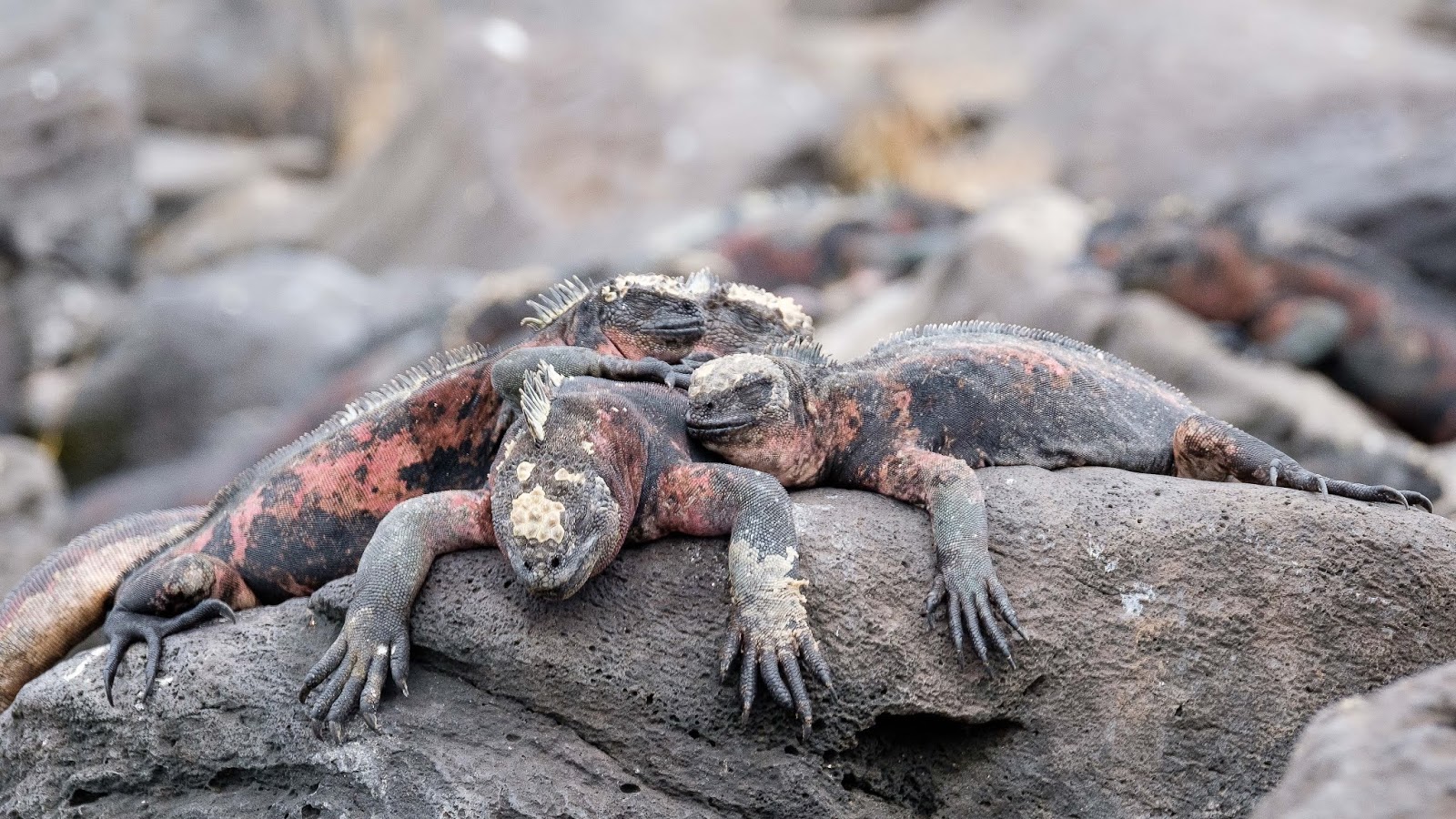
...marine iguanas on land and under water
Marine iguanas warming up in the sun
...lava lizards
Lava lizard
...colourful crabs
Crabs with a friend
...sea lions on shore
The ever curious sea lions
...giant tortoises
Giant tortoise... looks a bit like ET
...flightless cormorants
Flightless cormorants watching an intruder
...Galapagos penguins on land
Galapagos penguin couple
...very colourful flamingoes
Very graceful indeed
…walking on lava fields
Some beautiful patterns in the lava fields
...beautiful scenery after climbing mountains
Looking out over some of the Galapagos landscape
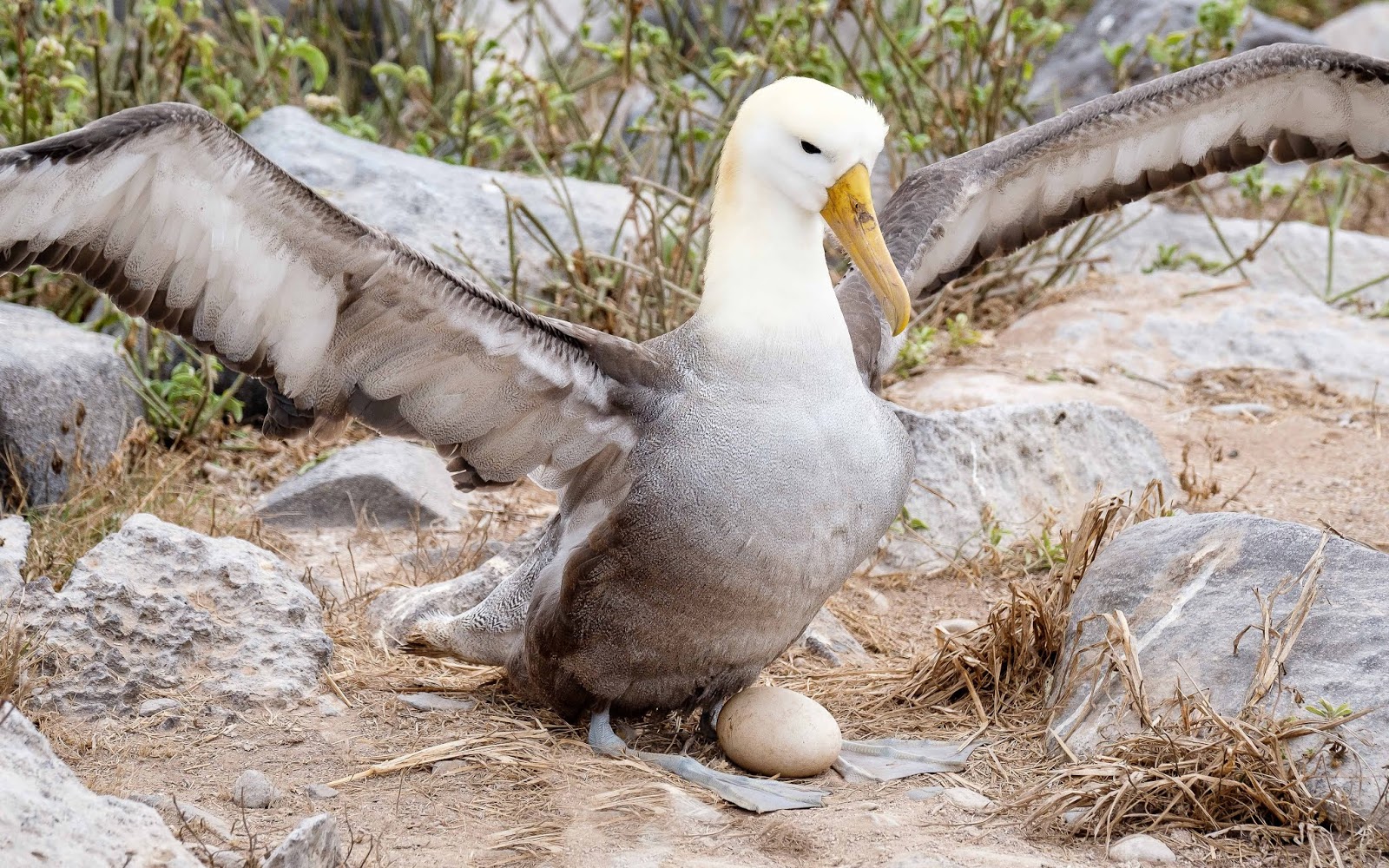
… watching the graceful Galapagos (Waved) Albatrosses
Albatross having a stretch whilst sitting on its egg
Magnificent albatross in flight
If considering a visit to the Galapagos, which we would highly recommend, especially if doing some or all of it on a boat as we did, it would be prudent to research each ship and study cabin layouts and sizes.

Some of the crossings between islands are fairly long, like 7-10 hours and the long ones typically occur at night, when much needed sleep is required.  Our boat rocked and rolled a bit during these transitions between islands, meaning we were a little sleep deprived the next day.

Since visiting the Galapagos Islands there have been two volcanos erupt, one on Isla Fernandina and the other on Isla Isabella from a volcano we climbed to the rim of.

After 2 weeks on the boat, we did enjoy a bit of chill time on San Cristobal Island for 2 days before flying back to Guayaquil on mainland to start the rest of our travels through Ecuador, so more on that next post… go well.